Posts

The EU is not a bastion of protectionism
Image
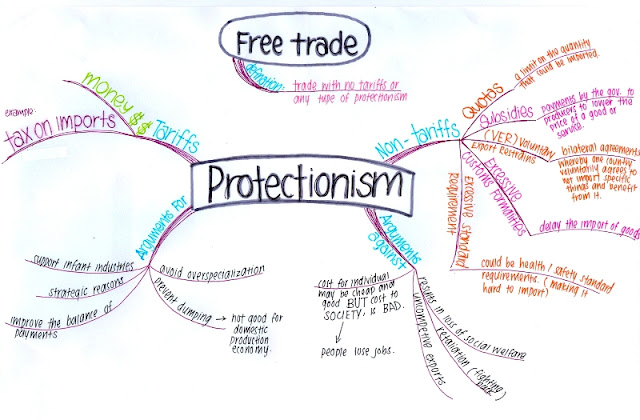
Jamie Powell at FT Alphaville has debunked the USA's claim to be the least protectionist trade area in the world . With the help of a couple of useful charts, he shows that it comes in a modest ninth on the list in trade-weighted terms. Go Jamie. The "victim America" narrative really needs to be stamped on, hard. America's trade deficit is not caused by mercantilist trade policies in other countries, it is an inevitable consequence of the dominance of the dollar - and is thus a measure of America's post-war success. But in the course of debunking the USA, Jamie also incidentally debunked the Ultra Brexiters. The Ultras insist that the EU is a bastion of protectionism, with extremely high tariff barriers to third countries. Indeed it does have very high tariffs for some products, mostly agricultural. But in the trade world, fallacies of composition abound. It is not safe to allege that a country or a trade bloc is extremely protectionist simply because it ha...

The sad story of Maplin Electronics

Image
Last week saw two high-profile corporate failures in the UK. Toys R Us finally went into administration after a stay of execution over Christmas. And private equity firm Rutland Partners pulled the plug on geeky electronics retailer Maplin. Total job losses from both failures amount to something in the region of 5,000 across the whole of the UK. No-one was particularly surprised by the failure of Toys R Us. The company had proved slow to respond to the rise of online shopping and the trend away from large out-of-town retail outlets in favour of small local shops. In the US, Toys R Us filed for Chapter 11 bankruptcy protection (the American equivalent of administration) in September 2017. Despite the American company's insistence that its European operations were not affected, it was almost inevitable that the UK subsidiary would eventually follow suit. British consumers are shifting to online shopping every bit as rapidly as consumers across the Pond, and the trend towards l...

An Alternative Brexit Polemic

Image
You would think, wouldn't you, that an "Alternative Brexit Economic Analysis" by four highly experienced and qualified economists would be a rigorous exercise in economic forecasting, supported by excellent econometrics and with care taken to avoid confirmation and selection bias?  A new paper from the Brexit-supporting thinktank Economists for Free Trade critiques the Government's recent forecast that Brexit would cause a GDP loss of between 2 and 8 percent over 15 years relative to remaining in the EU, with the "hardest" Brexit causing the greatest loss. Or at least, that's what the paper says it is doing. But the way it goes about it is decidedly odd for something claiming to be an "Alternative Brexit Economic Analysis". The first section of the report is an extensive discussion of the reasons why no-one should ever believe forecasts produced by the UK Civil Service. The authors argued that because HMT's forecasts are frequently w...

The misery of Mitie

Image
The failure of Carillion has brought to light widespread moral hazard in the outsourcing sector. For years, companies that deliver crucial public services relied on expectation of government support to keep their borrowing costs low and enable them to please shareholders by giving dividends they couldn't afford. They, and the banks and investors that funded them, assumed they were too important to fail. So when Carillion was on the brink of failure, RBS tightened the screws , clearly believing that the UK government would eventually cough up (my emphasis) : RBS....insisted that this revised arrangement "would be in place until support from [the Government] had been agreed and that the terms of this support would determine whether other uncommitted facilities with RBS would be withdrawn". But they were wrong. The UK government refused to provide support, preferring to allow Carillion to fail. That decision shocked the outsourcing sector to the core. In effect, it ha...

Clearing out Carillion's cupboards

Image
Those excellent researchers at the House of Commons Library have produced a briefing paper on the Carillion collapse. It is clear, succinct and well-researched. And extremely grim. The researchers seem to have gone back through the reports & accounts to about 2009. And they conclude that Carillion was a basket case not just in the last year of its life, but from about 2011 onwards. I've now done the same exercise, and I agree with them. Carillion's cupboards were virtually bare, and the little that was in them stank. This chart summarises the mess that Carillion got itself into: We need to be a little careful with this chart, of course, since it is comparing stocks and flows. But what it shows is that a large uplift in loans in 2010-12 generated absolutely no additional net cash revenue - in fact cash revenue actually fell between 2009 and 2016. For a company whose entire business model relies on increasing net cash flow, this is disastrous. The distressed upt...

The Carillion whitewash

Image
The Carillion whitewash has begun. Carillion's interim CEO, Keith Cochrane, is spinning the line that had banks not pulled funding, its collapse could have been averted. And the Financial Times has released details of a letter Carillion sent to the Government at the beginning of January, in which it asked for short-term advances to tide it over while it underwent restructuring. Labour MP Pat McFadden has written to the Treasury Secretary asking whether it would have been more cost-effective for the U.K. Government to support Carillion, rather than allowing it to collapse. This looks to me like a campaign to deflect blame from Carillion's management to its lenders and customers. We are being led to believe that it wasn't insolvent, it was just illiquid, and depriving it of short-term funds caused a completely unnecessary collapse. Deliciously, the bank Cochrane principally accuses of precipitating Carillion's collapse by depriving it of funds is RBS, which wa...