Posts

Brexit, trade and echoes of the past
Image
Brexit supporters have been severely critical of the OBR for its grim outlook for the UK post Brexit. The OBR is by no means the most negative of the professional forecasting bodies, and historically its forecasts have tended to err on the side of optimism, as Duncan Weldon observes . But it struggles to find anything good to say about post-Brexit Britain. In particular, it is distinctly negative about the future for Britain's external trade. Brexit is above all a shock to trade, since its primary impact will be on Britain's trading relationships, not only with the EU but with other countries too. At present, we have no real idea what these will look like once the UK has left the EU. The OBR is therefore forecasting under extreme uncertainty. If there is one thing we can be sure of when forecasting under extreme uncertainty, it is that the forecasts are even more likely than usual to be wrong. This does not indicate that the forecasters are biased. It just means they have...
True patriotism

Image
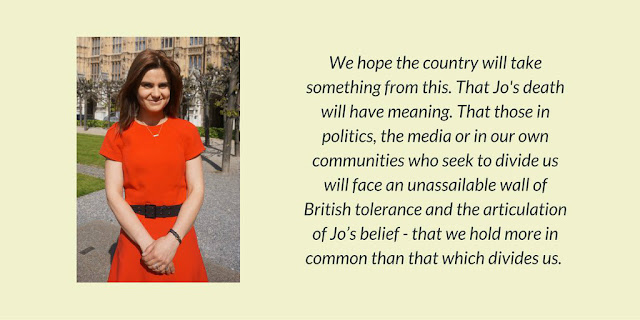
Treason is popular. As the tide of protectionism rises around the world, the concept has come back into vogue. If you believe in the right of all people, whatever their colour or creed, to seek life, liberty and happiness for themselves and their children, you are unpatriotic. I am one of many who have been labelled a "traitor" for voting Remain in the EU referendum. But I have got off lightly. The same label cost Jo Cox MP her life. Jo was a fervent Remain supporter. She believed strongly that Britain would be better off as a member of the EU. As Thomas Mair shot and stabbed her in June 2016, shortly before the EU referendum, he shouted "This is for Britain”, “Keep Britain independent”, and “Britain First”. Political assassination? No. Execution. Treason used to be a capital offence, and Mair regarded Jo as a traitor because of her support for Remain. To him, killing Jo was an act of patriotism. Patriotism is taking an ugly turn. We wear poppies on Armistice Day...

Reinventing work for the future

Image
We have a crisis of work. The secure, well-paid jobs of the past - many of them in manufacturing - are disappearing. What is replacing them is insecurity and uncertainty. Low-paid, part-time, temporary and seasonal work. The "feast or famine" of self-employment. The so-called "sharing economy", where people rent out their possessions for a pittance. The "gig economy", where people are paid performance by performance - or piece by piece. " Piecework ", we used to call it. Perhaps we should rediscover this name. Piecework has been the lot of most humans throughout history. Secure full-time jobs for wages have existed for less than a hundred years. And they were never available to everyone. In the post-war "golden age" of manufacturing to which many would like to return, most men had secure full-time jobs - but women did not. My father left school at 16 and went to work for an insurance company. He stayed with that company for hi...

The dangerous scheming of stupid politicians

Image
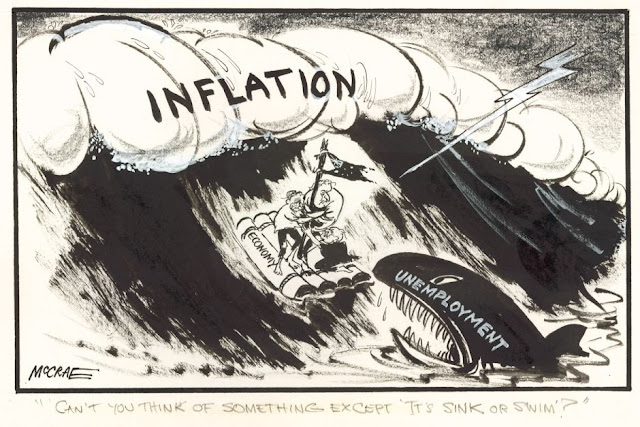
There is growing speculation that the Governor of the Bank of England, Mark Carney, will not extend his term. Carney originally agreed to a five-year term, which would end in 2018, but it had been thought he might extend to the more usual eight years for a Bank of England governor. This is now looking increasingly unlikely. Carney has come under fire from pro-Brexit politicians for warning that Brexit is likely to increase inflation and unemployment and reduce economic growth. They accuse him of "talking down" the UK. This is some chutzpah, from politicians whose incompetence and arrogance has stunned the world. If anyone is "talking down" the UK, it is the Three Clowns currently running the Brexit project, and their baying packs of supporters. I have been severely critical of Bank of England policies. I don't like the over-reliance on QE: I think it is a useful crisis tool, but far too much has been expected of it. I think that the independence of the ...

Raising interest rates is not that simple, Lord Hague

Image
The present period of very low interest rates is widely assumed to be temporary, a consequence of the 2008 financial crisis and subsequent central bank action. Because of this, as the financial crisis fades into the mists of time, there is growing political pressure for "normalisation" of interest rates. Here, for example, is William Hague warning that central banks must start to raise rates or face losing their independence: The only way out is for the US Fed to summon the courage to lead the way to higher interest rates, and others to follow slowly but surely. If they fail to do so, the era of their much-vaunted independence will come, possibly quite dramatically, to its end. Hague gives ten reasons why low interest rates are a bad idea. His points can be summarised thus: the "reach for yield" by savers who want higher returns drives up the price of assets higher asset prices increase wealth inequality, fuelling popular anger pension funds are struggling, ...

State pensions: property right or benefit?

Image
I know that lots of you are heartily sick of the WASPI campaign, but it does have a tendency to throw up interesting issues. This time, it is the legal status of the UK's state pension. A couple of days ago, the WASPI campaign announced a crowdfunding campaign to raise funds for legal action against the Government. Their CrowdJustice page says that legal action would potentially be twofold: (this is a screen print from the CrowdJustice page. Regular readers of my blog will be aware that I do not post direct links to WASPI campaign material.) Personally, I am of the opinion that judicial review of the legality of the state pension age changes in the 1995 and 2011 Pension Acts is a non-starter. The timetables for the changes are built into the Acts themselves, so any successful challenge to them would require repeal or amendment of one or both Acts. Since the UK has no written constitution and Parliament is sovereign, judicial review cannot be used to challenge primary le...

The dominance of Brexit

Image
Some people have been saying that sterling's fall has nothing to do with the Brexit vote. Sterling was already falling before the vote, they say, because of the UK's wide and growing current account deficit. So I thought I would fact check this. Here is the UK's current account deficit since 1987, courtesy of ONS : Well, ok, it has rarely been anywhere near balance in the current century, and it has been trending downwards since 2011. Now let's look at sterling. Here is sterling's trade-weighted exchange rate since 1992, courtesy of the Bank of England (via this House of Commons briefing paper ): Umm. The correlation between the current account deficit and the trade-weighted value of sterling appears to be negative. Sterling has been rising since 2011 - until this year. This is actually reasonable. The trade-weighted value of a currency reflects the external performance of the economy. And for a long time now, current account deficits have not been r...