Posts

State pensions: property right or benefit?

Image
I know that lots of you are heartily sick of the WASPI campaign, but it does have a tendency to throw up interesting issues. This time, it is the legal status of the UK's state pension. A couple of days ago, the WASPI campaign announced a crowdfunding campaign to raise funds for legal action against the Government. Their CrowdJustice page says that legal action would potentially be twofold: (this is a screen print from the CrowdJustice page. Regular readers of my blog will be aware that I do not post direct links to WASPI campaign material.) Personally, I am of the opinion that judicial review of the legality of the state pension age changes in the 1995 and 2011 Pension Acts is a non-starter. The timetables for the changes are built into the Acts themselves, so any successful challenge to them would require repeal or amendment of one or both Acts. Since the UK has no written constitution and Parliament is sovereign, judicial review cannot be used to challenge primary le...

The dominance of Brexit

Image
Some people have been saying that sterling's fall has nothing to do with the Brexit vote. Sterling was already falling before the vote, they say, because of the UK's wide and growing current account deficit. So I thought I would fact check this. Here is the UK's current account deficit since 1987, courtesy of ONS : Well, ok, it has rarely been anywhere near balance in the current century, and it has been trending downwards since 2011. Now let's look at sterling. Here is sterling's trade-weighted exchange rate since 1992, courtesy of the Bank of England (via this House of Commons briefing paper ): Umm. The correlation between the current account deficit and the trade-weighted value of sterling appears to be negative. Sterling has been rising since 2011 - until this year. This is actually reasonable. The trade-weighted value of a currency reflects the external performance of the economy. And for a long time now, current account deficits have not been r...

The currency effects of Brexit

Image
Sterling is falling. Predictably, the financial press describe its slide as a " pounding " and gleefully tell us that sterling is the worst-performing currency after the Argentinian peso . But some people are cheering. Falling sterling is good for exports, isn't it? So if the pound keeps falling, the UK's large trade deficit will start to shrink, reducing the UK's dependence on external financing and hence its vulnerability to a " sudden stop ". Sadly, it's not that simple. Falling sterling is not an unalloyed good for exporters. The real effect is considerably more nuanced, and over the longer term, not necessarily positive. As an exporter myself, I am certainly enjoying the pound's fall. These days, most of my income is in US dollars. This is how GBRUSD has performed this year: Since my income is in dollars but my outgoings are in sterling, I've had a pretty substantial pay rise. But my chickens will come home to roost shortly....

Why is global trade so weak?

Image
Global trade is awful. Really, it is. For the last five years, trade volumes have been growing at their slowest sustained rate since the early 1980s. Here's a horrible chart from the World Trade Organisation's latest forecast: And in the last year, things have got worse: Import demand of developing economies fell 3.2% in Q1 before staging a partial recovery of 1.5% in Q2.  Meanwhile, developed economies recorded positive import growth of 0.8% in Q1 and negative growth of -0.8% in Q2.  Overall, world imports stagnated in the first half of 2016, falling 1.0% in Q1 and rising 0.2% in Q2.  This translated into weak demand for exports of both developed and developing economies.  For the year-to-date, world trade has been essentially flat, with the average of exports and imports in Q1 and Q2 declining 0.3% relative to last year. Oh great. The WTO's chart shows that flat trade eventually translates into flat growth. And as this chart from the World Bank shows, gro...

A dent in the surface of time

Image
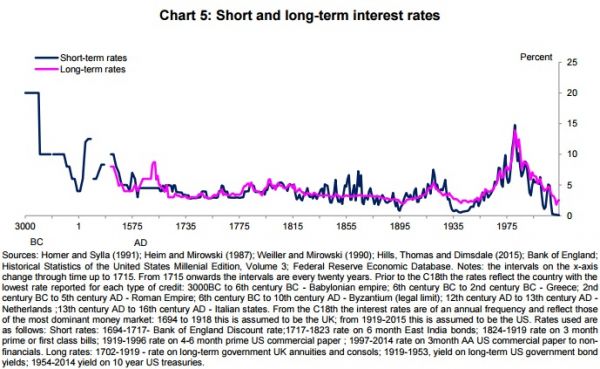
This chart has been fascinating me for ages. It was produced by the Bank of England to illustrate a speech by Andy Haldane . Shock, horror - we have the lowest interest rates for 5,000 years. Even in the Great Depression they were higher than they are now. These are, of course, nominal interest rates. Real interest rates are even lower - though not by much, since inflation is close to zero in all major economies. Note also the divergence of long-term and short-term interest rates. This is encouraging, since it suggests that investors view future prospects as brighter, though hardly scintillating. Central banks have been trying to close that gap with various monetary policy tools, the idea being to bring forward some of that future enthusiasm into the present day. But so far, all they have succeeded in doing is depressing expected interest rates far into the future. Now, policy makers are beginning to talk about interest rates remaining permanently lower than their long-run av...

Some unpleasant trade realities

Image
Well, this is fun. YouGov has asked the public which countries the UK's new trade negotiators (if and when they are recruited) should prioritise in their quest for free trade deals. Unsurprisingly, the US and the EU (considered as a whole trading bloc) came top of the list. But as ever, the devil is in the detail. These charts show the difference between the public's perception of the importance of a country versus its exports and GDP rankings: Now, of course the exports ranking is the current situation. We would expect free trade agreements to change this ranking, since countries with which the UK has free trade agreements should move up the exports ranking, and those with which it does not should correspondingly move down. The EU is currently top of the exports ranking because the UK is part of the single market. Once the UK is no longer part of the single market - as seems increasingly likely - the ranking might change. The GDP ranking is therefore possibly mo...

Are inheritance taxes unfair?

Image
Are inheritance taxes unfair? Many people think they are. "Why should I be taxed twice on money I've earned during my lifetime?" they say. This is, of course, a fallacy. Dead people don't pay taxes. Living ones do. So inheritance tax is not double taxation of money the dead person earned while they were still alive. It is taxation of an unearned windfall for the people to whom they leave their assets, usually their children. Other forms of unearned income, such as interest on savings and capital gains, are taxed. Why should someone be taxed on unearned income they receive as a result of investments made from their own earnings, but not on unearned income they receive as a result of investments made from someone else's earnings? That doesn't look very fair, does it? Surely taxing that unearned windfall must be fair.  No. According to the economist Greg Mankiw, taxing inheritance is fundamentally unfair: From my perspective, the estate tax is a...