Posts

The Chancellor's "full employment" ambition is not quite what it seems

"The UK’s Chancellor of the Exchequer, George Osborne, has announced that his priority is jobs. In his words (from his  Twitter account ): This week sees biggest personal & business tax cuts for 2 decades. Part of our plan to build an economy that supports full employment — George Osborne (@George_Osborne) March 31, 2014 Today have set an ambition for the UK to have the highest employment rate in G7- best place to create a job and to get a job — George Osborne (@George_Osborne) March 31, 2014 "This is more than slightly confused." Read on here . (Pieria)

The UK's Real Problem

The UK's current account deficit is a matter for some concern, as is its fiscal deficit, because both make it vulnerable to sudden reversal of capital flows. But these aren't its real problem.... More here  (Forbes).

Spain, the ECB and the power of talk

Over at Forbes, more on why the ECB won't do QE despite Spanish inflation having turned negative: Spain is in a mess. Over a quarter of its adult workforce is unemployed, and  according to CIB Natixis  it has lost 25% of its production, even more than Greece. Spain’s inflation rate has been falling steadily and has now turned negative: the most recent retail sales figures  show a fall  of 0.2%. Various people  anticipate  ECB easing monetary policy because of the growing threat of deflation in Spain. But this is to misunderstand the role of monetary policy in a currency union. The ECB sets monetary policy for the union as a single unit, not for its individual components. Deflation in Spain is a driver of ECB decisions only to the extent that it depresses Euro zone CPI. And I’m sorry if this sounds brutal, but Spanish unemployment is of no consequence, since the ECB does not have a mandate to target unemployment even at the Euro zone level, let alo...

Rediscovering IS-LM

Image
At Pieria, I attempt to show how Paul Krugman's favourite economic model can give important insights in an endogenous money framework: "This post was sparked by recent conversations with people who have opposing views of how money creation works. Some people think that classical models such as IS-LM don't work with endogenous money theory, therefore the models need to be discarded: others think that there's nothing wrong with the model and the problem is endogenous money theory. Personally I think that simple models like IS-LM can be powerful tools to explain aspects of the working of a market economy, and it behooves us therefore to find ways of adapting them to work with an endogenous fiat money system.So this is my attempt..... " Read on here .

Why the ECB won't do QE

Image
Or anything else, for that matter. (But they might talk about it.) With forecasts like these, who needs action? H/t Frederick Ducrozet (@fwred on Twitter)

Interest rates and deflation

Image
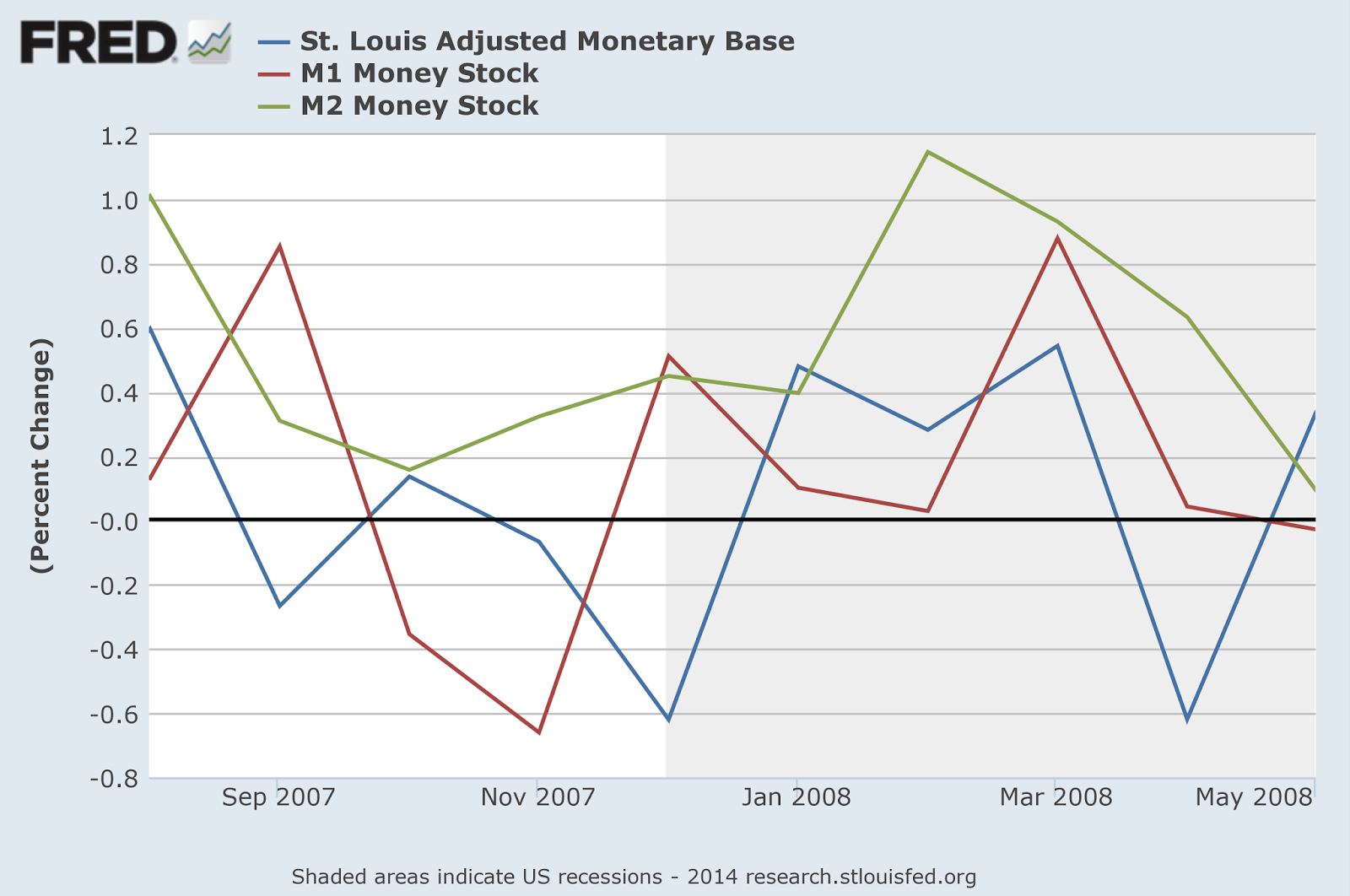
Scott Sumner argues that when the monetary base is fixed , low interest rates are deflationary. I've emphasised the fixed monetary base because it is an important condition. If the monetary base is NOT fixed then the relationship between low interest rates and deflation is much less clear. Logically, this makes sense. If the supply of base money is fixed, then falling interest rates indicate* rising demand for base money, increasing its value and therefore causing prices to fall. Aficionados of a classical gold standard will recognise this as "benign" deflation. Falling interest rates when the monetary base is fixed can be an indicator of healthy growth. Unfortunately the period that Sumner chooses as his example of falling interest rates and a fixed monetary base was anything but healthy. It was August 2007 to May 2008, which was the height of the subprime crisis and encompassed the failure of Bear Sterns. Strictly speaking, the monetary base was not "fixed...

Three dangerous economic ideas

My latest post at Forbes considers what happens when policy makers persist with policies whose underlying economic theory has been shown to be wrong*: This post by Alex Marsh got me thinking. If economic ideas influence policy makers, what happens when the economic ideas turn out to be wrong? This is not an idle question. Recently there have been three examples of economic ideas that have had huge impact on policy – and that have subsequently been shown to be false. Read on here . * Of course some people will argue that the three economic ideas I have identified are not wrong - it is the research debunking them that is wrong.