Posts

When populism fails

Image
At the Battle of Ideas last Saturday, a panel on "populism" spent an hour and a half discussing everything except economics. Sherelle Jacobs of the Telegraph called for the Tory party to replace what she called a "twisted morality of sacrifice and dependency" with the "Judaeo-Christian" values of thrift and personal responsibility. And when a brave audience member asked "shouldn't we be discussing economics?" Tom Slater of Spiked brushed him off and carried on talking about cultural issues. Economics be damned, populism is all about morality and culture.  But important though morality and culture are, it is economics that really matters. Rudiger Dornbusch's work on macroeconomic populism shows that populism eventually fails because the economics don't work. And when it does, the people who suffer most are those the populists intended to help.  In this study (pdf), Dornbusch and Sebastian Edwards define macroeconomic populism thus: Ma...

What was the real reason for the Bank of England's gilt market intervention?

Image
Why did the Bank of England intervene in the gilt market this week? The answer that has been doing the rounds is that it was protecting the solvency of pension funds. But this doesn't make sense to me. The Bank doesn't have any mandate to prevent pension funds going bust. And anyway, the type of pension fund that got into trouble isn't at meaningful risk of insolvency. There was never any risk to people's pensions.  I don't think the Bank was concerned about pension funds at all. I think it had a totally different type of financial institution in its sights.  Let's recap the sequence of events from a market perspective. This was, on the face of it, a classic market freeze. Pension funds sold assets, mainly long-dated gilts, to raise cash to meet margin calls on interest rate swaps (of which more shortly). The sudden influx of long gilts on to a market already spooked by an extremely foolish government policy announcement caused their price to crash. I am told th...

Celsius is heading for absolute zero

Image
Yesterday, the failed crypto lender Celsius filed a monthy cash flow forecast and a statement of its assets and liabilities held in the form of cryptocurrency and stablecoins. They showed that the lender is deeply underwater and will run out of money within two months.    Today, Celsius presented an update regarding its chapter 11 bankruptcy plans. Reading this, you'd think it was a different company. Liquidation isn't on the agenda. No, they are talking about "reorganization" and and seeking debtor-in-possession (DIP) financing:  DIP financing is a specialist form of finance for companies in chapter 11 bankruptcy to enable a company to continue operating. It usually takes the form of term loans. DIP loans are secured on the company's remaining assets and are typically senior over all other claims, so must be repaid before claims from existing creditors can be settled. Because DIP finance dilutes existing claims, the bankruptcy court must agree to it. In Celsius...

Why Coinbase's balance sheet has massively inflated

Image
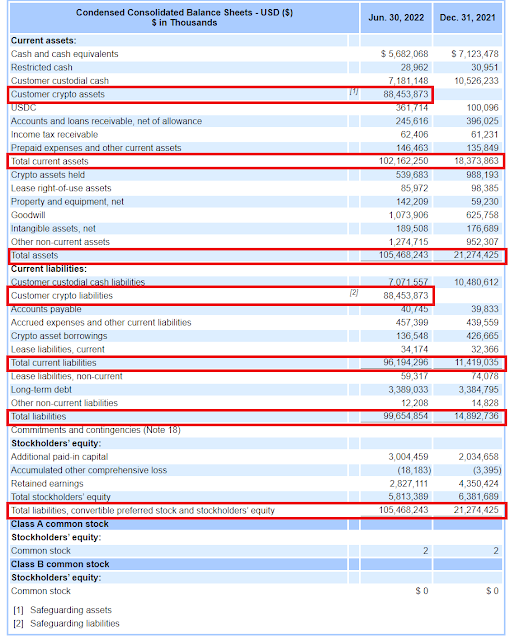
Coinbase recently filed its interim financial report. It makes pretty grim reading. A quarterly net loss of over $1bn, net cash drain of £4.6bn in 6 months, fair value losses of over 600k... To be sure, Coinbase is not on its knees yet. It still has $12bn of its own and customers' cash (both are on its balance sheet), and a whopping asset base. In fact its assets have increased - a lot. As have its liabilities. Coinbase's balance sheet is five times bigger than it was in December 2021.  Here's Coinbase's balance sheet, as reported in its 10-Q filing . I've outlined the relevant items in red:   There's a new asset called "customer crypto assets" worth some $88.45 bn, matched by a new liability called "crypto asset liabilities". This asset and its associated liability are by far the biggest items on Coinbase's balance sheet. Footnotes to the balance sheet describe these new items as "safeguarding assets" and "safeguarding lia...

The ones who stay in Omelas

Image
Ursula Le Guin's short story " The Ones Who Walk Away From Omelas " contains a terrible moral conundrum. Many people have agonised over it: to my knowledge, no-one has solved it. Attempts that I have seen all in some way change the framing of the story, whether by justifying blood sacrifice , insisting that there must be a better way , or creating a better alternative . But if you change the framing, you have not solved the problem. You have avoided it. As I read through Le Guin's story to the end, I recognised the moral conundrum. It is similar to the one I posed in this piece . In Le Guin's story, as in mine, the facts don't matter. It is what people believe that matters. In Le Guin's story, millions of people believe their happiness and that of everyone they love - indeed, their very existence - depends on a child being condemned to live in darkness, pain and squalor. They accept that the child's suffering is necessary, so they do nothing about it. ...

Where has all the money gone?

Image
The collapse of Terra in May sent shock waves round the crypto world, triggering domino-like collapses of crypto companies. One of those companies was the investment fund Three Arrows Capital. At the time, everyone thought 3AC was a conservatively-managed investment company that was simply the unfortunate victim of an unforeseen event. If anyone was to blame for 3AC's collapse, it was Do Kwon.   How wrong they were. Since 3AC was ordered into liquidation by a British Virgin Islands court, more  and more creditors have emerged from the woodwork claiming they are owed money. The liquidators have filed emergency motions to freeze 3AC's assets because there is evidence that funds are being moved out of reach. And 3AC's co-founders, Su Zhu and Kyle Davies, have done a runner, though Bloomberg says they are planning to set up shop in Dubai.  The liquidators applied to the Singapore High Court to have the BVI liquidation order recognised in Singapore. This would give them a...

Why Celsius Network's depositors won't get their money back

Image
The crypto lender Celsius has filed for Chapter 11 bankruptcy. This should come as a surprise to absolutely no-one, though the grief and pain on Twitter and Reddit suggests that quite a few "Celsians" didn't want to believe what was staring them in the face. Celsius suspended withdrawals nearly a month ago. So far, every crypto lender that has suspended withdrawals has turned out to be insolvent. There was no reason to suppose that Celsius would be different.   Celsius's bankruptcy filing says the company has assets of $1 - 10 bn and a similar quantity of liabilities:  This doesn't tell us much about the extent of the company's insolvency. But rumours have been circulating of a $2bn hole in its balance sheet. In May,  according to Coindesk , the company said it had $12bn of what Celsius calls "customer assets" and Coindesk calls "assets under management", and $8bn lent out to clients. So "assets under management" seem to have fal...