Posts

Showing posts with the label work

Why the Tories' "put people to work" growth strategy has failed

Image
What do you do when your economy is in the doldrums and you need to kickstart growth? Why, you put more people to work, that's what you do. This has been the Tories’ strategy since 2010. The sustained attack on welfare benefits has all been focused on “making work pay” - encouraging, and at the margin forcing, people with illnesses, disabilities and caring responsibilities into paid work.  But there is another way of putting more people to work, and that is to import them. In a new report , the centre-right CPS thinktank says that importing people to kickstart growth has been the unspoken strategy of successive governments since 1997. And it argues that the strategy has manifestly failed.  In my latest Substack piece , I examine the reasons the report advances for this failure, and conclude that the "put more people to work" strategy has not failed. It has in fact compensated to some degree for the catastrophic failure of innovation, capital investment and productivity si...


A Financial View of Labour Markets

Image
We are used to thinking of workers as free agents who sell their labour in a market place. They bid a price, companies offer a lower price and the market clearing rate is somewhere between the two. Free market economics, pure and simple.  But actually that's not quite right. The financial motivations of workers and companies are entirely different. To a worker, the financial benefit from getting a job is an income stream, which can be ended by either side at any time. But to a company, a worker is a capital asset.  This is not entirely obvious in a free labour market. But in another sort of labour market it is much more obvious. I'm talking about slavery.  Yes, I know slavery raises all sorts of emotional and political hackles. But bear with me. I am only going to look at this financially. From a financial point of view, there are more similarities than differences between the slave/slaver relationship and the worker/company relationship - and the differences are not nece...

Hitting the wall

Image
It is 2.30 am, and I can't sleep. Today I must file my final piece for American Express's FXIP blog , which is being mothballed. Writing for that blog has been my main source of income for the last four years. Once it is gone, my income will once again become precarious and inadequate, as it has been all too often in the past. Hence my sleeplessness. To be perfectly honest, I'm not sorry that the blog is closing. I've done some interesting work for it, and learned a lot. And it has been a reliable source of income during the difficult times of the last three years. For that, I am grateful. But I don't enjoy writing for it. The house style is dry to the point of desiccation, devoid of all opinion, emotion and metaphor. It is also SEO-driven, so I am constantly trying to find ways of including key words assigned by someone else. True, the key words are set from the brief, but it means there is no flexibility. I can't simply go where my mind leads, as I do wh...

The Broken Contract

Image
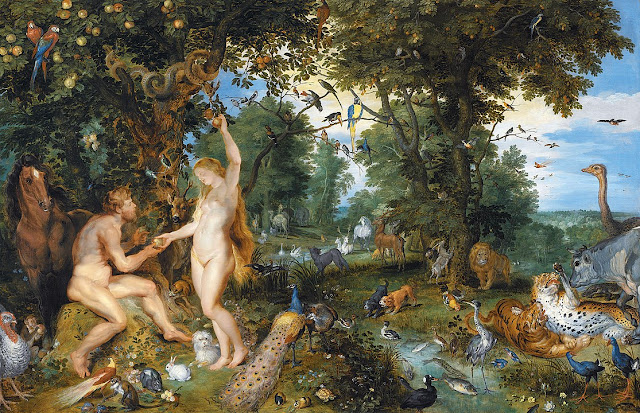
So the Lord God said to the serpent,  “Because you have done this, cursed are you above all livestock and all wild animals! You will crawl on your belly and you will eat dust all the days of your life. And I will put enmity between you and the woman, and between your offspring and hers; he will crush your head, and you will strike his heel.” To the woman he said, “I will make your pains in childbearing very severe; with painful labor you will give birth to children. Your desire will be for your husband, and he will rule over you.” To Adam he said, “Because you listened to your wife and ate fruit from the tree about which I commanded you, ‘You must not eat from it,’ cursed is the ground because of you; through painful toil you will eat food from it all the days of your life. It will produce thorns and thistles for you, and you will eat the plants of the field. By the sweat of your brow you will eat your food until you return to the...

An Experiment with Basic Income

Image
In 1795, the parish of Speen, in Berkshire, England, embarked on a radical new system of poor relief . Due to the ruinous French wars and a series of poor harvests, grain prices were rising sharply. As bread was the staple food of the poor, rising grain prices increased poverty and caused unrest. Concerned by the possibility of riots, the parish decided to provide subsistence-level income support to the working poor. The amounts paid were anchored to the price of bread. Each member of a family qualified for a payment, so the larger the family, the more they received. In effect, it was a system of in-work benefits. Subsistence-level income support already existed for the non-working poor. The Poor Laws , first introduced in Elizabethan times, distinguished between different categories of “poor” and treated them differently. At the time that the Speenhamland system was introduced, the old, inflrm and children were placed in poorhouses, where they were cared for and were not expecte...

Why labour markets don't clear

Image
This post originally appeared on Pieria in July 2014.  Roger Farmer has a blogpost in which he shows that labour markets don’t clear. Specifically, employment varies with the business cycle, whereas the labour force participation rate and hours worked only show long-term secular trends. During cyclical downturns, therefore, we must conclude that there is more labour available than there are jobs. New Keynesians say that the reason for this is sticky wages . If only nominal wages could fall enough,the market would clear and there would be no cyclical increase in unemployment. Therefore there should be labour market deregulation so that wages can flex with the business cycle. Roger Farmer questions this: he argues that the market simply does not clear at any wage. I disagree. I think the market does clear – when wages fall to starvation level. Humans need a minimum income to sustain life, but employers have no responsibility for ensuring that the remuneration of employee...

Job guarantees for the disabled

Image
It took me a while, but it has finally dawned on me why job guarantees might be very popular in the U.S., even among the sick and disabled. The clue is in this response to a tweet from Nathan Tankus: It's not just a problem for the technically disabled. Health issues are the #1 reason why people miss work and lose jobs. Many are too weak or previously injured or old before their time. Until Medicare for all, JG with benefits would be a fantastic lift for many. — Bob Spencer (@binhkhe) August 24, 2018 Here in the U.K., access to healthcare is not dependent on being gainfully employed. But in America, it is. If you aren't working, your access to healthcare can be very limited. Thus, sick and disabled people who are unable to work can lose access to healthcare. The very people who need it most are denied it. But there is a fatal flaw in the notion that a job guarantee could compensate for lack of universal healthcare, even temporarily. No job guarantee scheme can possibl...

A very British disease

Image
The desire to judge people's motives rather than addressing their needs is a “British disease”. We have been suffering from it for hundreds of years, cycling endlessly through repeated cycles of generosity and harshness. Each cycle ends in public outrage and an abrupt reversal: but the memory eventually fades, and the disease reappears in a new form. In this post, I outline the tragic history of Britain's repeated attempts to "categorise the poor". For centuries, successive British social systems have recognised that there are people who cannot work, whether because they are too young, too old, too ill or too infirm. These people need to be provided for by others – in the first instance families, but where family support networks break down, support must be provided by the wider community. And for centuries, successive British social systems have also recognised the existence of people who are perfectly capable of working but are not doing so. Most of these ...