Posts

Showing posts with the label GDP

Why the Tories' "put people to work" growth strategy has failed

Image
What do you do when your economy is in the doldrums and you need to kickstart growth? Why, you put more people to work, that's what you do. This has been the Tories’ strategy since 2010. The sustained attack on welfare benefits has all been focused on “making work pay” - encouraging, and at the margin forcing, people with illnesses, disabilities and caring responsibilities into paid work.  But there is another way of putting more people to work, and that is to import them. In a new report , the centre-right CPS thinktank says that importing people to kickstart growth has been the unspoken strategy of successive governments since 1997. And it argues that the strategy has manifestly failed.  In my latest Substack piece , I examine the reasons the report advances for this failure, and conclude that the "put more people to work" strategy has not failed. It has in fact compensated to some degree for the catastrophic failure of innovation, capital investment and productivity si...

The tragedy of Gaza

Image
Dear friends, I said I wouldn't post any more on this site. But Elon Musk doesn't like me posting Substack links on Twitter. And Substack itself is a mess. The home page looks amateurish, and new posts don't even appear on it until they've amassed enough views to push down previous posts. It's an absurd way of organising a site.  So I have decided in future to post links to my Substack posts here. Hopefully this will mean you can find them more easily, both on Google and Twitter. Some of my Substack posts have paywalls, but you will have the option to subscribe or opt for a free trial.  Here's the introduction to my latest Substack post, The Tragedy of Gaza . Click the link to read all of it. It is free to read. The Palestinian economy is enduring a fiscal crisis and the economic outlook is dire.” - IMF, 26th April 2022. I’m sure everyone realises by now that Gaza’s economy has fallen off a cliff. There is almost no productive activity, so GDP has collapsed an...

The Great Unemployment Fudge

Image
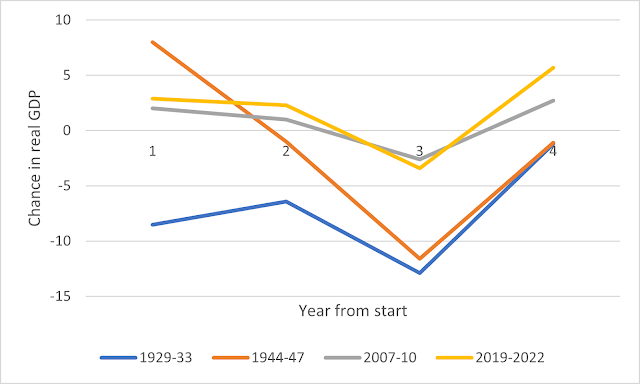
In the U.S., we are told, the post-World War II period was a golden age of full employment. High wartime government spending had brought to an end the double-digit unemployment and misery of the Depression, and as war gave way to peace, unemployment settled at a non-inflationary level of 3-5%. It's known as the post-war "economic miracle". But it's a myth. There was never full employment. The low unemployment of the post-war years is a massive statistical fudge. In fact, over five million people lost their jobs immediately after the end of the war, most of whom never worked again. But they were never listed as unemployed - because they were women.  The Great Unemployment Fudge started in the "Depression of 1946", described by the Cato Institute as "one of the most widely predicted events that never happened in American history". During the war, there was full employment, GDP was roaring and industrial production was at an all-time high. But much o...

The dismal decade

Image
Earlier today, the Governor of the Bank of England, Andrew Bailey, gave a speech at the Resolution Foundation outlining the nature of the Covid-19 crisis and the challenge that it poses for monetary policy. But as his speech progressed, it became clear that the Bank faces a much larger challenge. Covid-19 hit the UK economy at the end of a dismal decade. Returning to "where we were" before the pandemic won't be good enough.  Just how dismal the 2010s were is evident in this chart from Andrew Sentance:  Even before Covid-19 struck, average GDP growth was well below its historical average and heading downwards. The 2010s were, to put it bluntly, a decade of stagnation.  The 2000s were slightly worse, but that was because they included the deep recession after the financial crisis, during which the economy shrank by 6%. For the 2010s, there was no such excuse.  So Covid-19 hit an already under-performing economy. As a result, Sentance's forecast for the 2020s is frankl...

Trade, saving and an economic disaster

Image
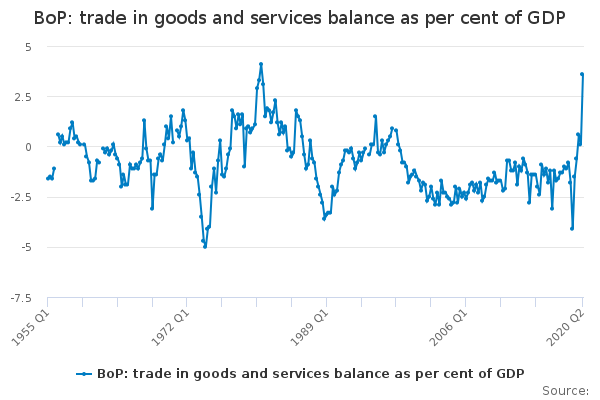
 The UK is running a trade surplus. No, really, I am not joking. This is from the ONS's latest trade statistics release : The UK total trade surplus, excluding non-monetary gold and other precious metals, increased £3.8 billion to £7.7 billion in the three months to August 2020, as exports grew by £21.4 billion and imports grew by a lesser £17.5 billion It's the first time the UK has run a trade surplus since the late 1990s:  And if you were thinking this was because of the lockdown, you would be wrong. The UK has been running a trade surplus since the beginning of 2020: Admittedly, the trade surplus widened under lockdown. But the UK economy reopened to some degree from June to August - and yet the trade surplus continues to widen. This is no doubt music to the ears of balance of payments obsessives. Could the UK at last be pivoting away from a consumption-led growth model to an export-led one?  At first sight, it appears so. Exports have increased more than imports. And...

So when did this recession start, exactly?

Image
Is the U.S. in recession? If so, when did the recession start, and what caused it?  The usual economic definition of "recession" is two successive quarters of negative GDP growth. But in Q1 2020, growth was positive, though it was apparently slowing sharply (more on this shortly): So using the standard economic definition, the U.S. is not yet in recession. But according to the Business Cycle Dating Committee of the National Bureau for Economic Research (NBER), the U.S. entered recession in February:  The committee has determined that a peak in monthly economic activity occurred in the U.S. economy in February 2020. The peak marks the end of the expansion that began in June 2009 and the beginning of a recession.  February? The  New York Fed's nowcasting report  for February showed no sign of recession. The most recent nowcast shows the economy dropping off a cliff at the beginning of April:  Of course, even nowcasts have lagging data. The date of the collap...

Patrick Minford's holidays

Image
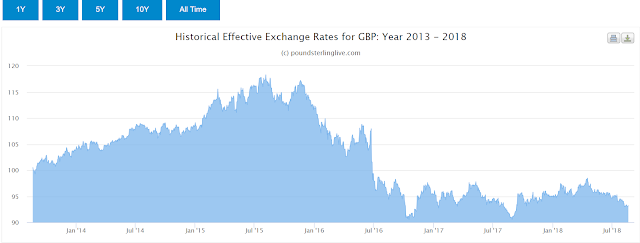
Skewering Patrick Minford has become something of an economists' bloodsport. I admit, I have done my fair share of Minford-bashing, though I do try to stay away from trade economics. Others are much better at lampooning Minford's antediluvian approach to trade economics than me. But when Minford starts pontificating on the effect of currency movements on the balance of trade, I can't resist getting out the shotgun. Minford is appallingly bad on anything that involves foreign exchange. He just doesn't seem to understand how floating exchange rates interact with trade dynamics and capital flows. So it is unsurprising that his latest venture into this complex subject is as disastrous as the last . Here is Minford, in the Express , talking about Brits and their holidays: The mood of British consumers is good, reflecting the fact that the economy continues to grow and create record employment. A staycation is best because of the Brexit devaluation, which makes Britis...

Productivity and Employment: A Cautionary Tale

Image
Ah, productivity. Who knew that our whole prosperity was totally dependent on a concept as nebulous as this? To be sure, it doesn't sound nebulous. It is output per worker per hour. What is so difficult about that? The problem is how you define "output". Usually, we take this to mean GDP (gross domestic product), though we might use GNP (gross national product) or GVA (gross value added). In this post, I shall use GDP. As Diane Coyle has engagingly written , GDP is a deeply flawed measure. Yet we are obsessed with it. The Eurozone uses government debt-to-GDP and deficit-to-GDP ratios to justify harsh spending cuts and tax rises. In the UK, "WE MUST PAY DOWN THE DEBT!" roar the headlines, entirely missing the point that debt-to-GDP is a ratio, so even if we never borrowed another penny, it would rise if GDP fell. Even if GDP growth remained positive, but slowed down - say to 1.5% per annum instead of the predicted 2% -  debt-to-GDP would take longer to r...