Posts

Showing posts with the label fiscal policy

Britain was not "nearly bust" in March

Image
"Britain nearly went bust in March, says Bank of England", reads a headline in the Guardian . In similar vein, the Telegraph's Business section reports "UK finances were close to collapse, says Governor": Eh, what? The Governor of the Bank of England says the UK nearly turned into Venezuela? Well, that's what the Telegraph seems to think:  The Bank of England was forced to save the Government from potential financial collapse as markets seized up at the height of the coronavirus crisis, Governor Andrew Bailey has said. In his most explicit comments yet on the country's precarious position in mid-March, Mr Bailey said 'serious disorder' broke out after panicking investors sold UK government bonds in a desperate hunt for cash. It left Britain at risk of failing to auction off the gilts needed to fund crucial spending - and Threadneedle Street had to pump £200bn into markets to restore a semblance of order. Reading this, you would think that the UK...

Why Central Bankers Don't Understand Inflation

Image
My debut post at CapX develops a theme I have written about many times. Central bankers are tasked with controlling inflation, but they don't understand it. For the last decade, central banks in developed countries have been pursuing policies designed to raise inflation. Quantitative easing, cheap funding for banks, tinkering with yield curves, low and negative interest rates – all aim to raise inflation to the ubiquitous 2% target. Understandably, central banks’ inflation forecasts assume that their policies will return inflation to target over the medium term. But as time goes by, and inflation stays stubbornly low, their forecasts are becoming increasingly difficult to believe. This does not bode well for central banks that depend above all on credibility..... Read on here . Related reading: Inflation is always and everywhere a political phenomenon Image is of the Bank of England's note printing centre at Debden. Image by  Benj Roberts - originally posted to F...

Inflation Is Always And Everywhere A Political Phenomenon

Image
We don't understand inflation. Those who lived through the high inflation of the 1970s are convinced that inflation is always and everywhere caused by wage-price spirals. Germans, economic Austrians and Bitcoiners are convinced that inflation is always and everywhere caused by central bank money printing. Small-state supporters are convinced that inflation is always and everywhere caused by profligate governments borrowing and spending excessively. Hard money enthusiasts are convinced that inflation is always and everywhere caused by currency devaluation. Every school of economics has its own theory of inflation. We don't even know what we mean by inflation. As the Cleveland Fed  entertainingly discusses , inflation originally meant expansion of (paper) currency in a manner that resulted in higher prices. But over time, that definition has widened to mean anything and everything that raises prices, not just monetary expansion. And not only consumer prices, either. We now ...

The foolishness of the old

Image
Most people want government to spend more money on them than on anyone else. This applies regardless of their tax contributions (those who don’t pay tax often demand more than those who do). And it is completely understandable. After all, charity begins (and when times are hard, ends) at home. So when voters in the US were asked what the government’s spending priorities should be, it comes as no surprise to discover that their preferences varied by age: As we would expect, the priorities of the young are education and jobs, the priorities of those of working age are jobs and benefits, while the priorities of the middle-aged and old are pensions and associated benefits (US pensions, pensioner benefits, Medicare, disability benefits and family support are all bracketed together as “social security”, but pensions are by far the largest proportion). Older people are also much more concerned about defence, no doubt because they have lived through successive wars and threats of w...

The terrible price of austerity

Image
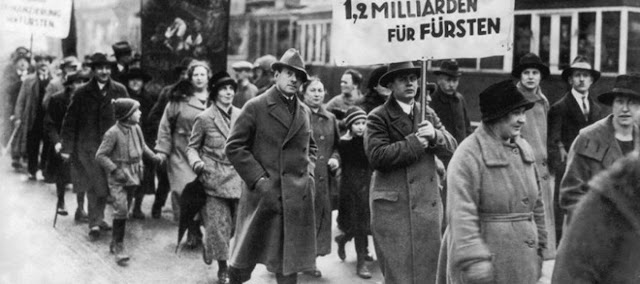
In August 2014, I wrote this post arguing that harsh austerity during the Depression caused Hitler's rise to power. At the time, my argument seemed controversial, at least in Germany. There, it is not the austerity of 1930-32 that is blamed, but the debt-driven hyperinflation of a decade earlier. Germans remain terrified of both inflation and debt to this day. I am certainly not the only person to identify a causative link between austerity and Hitler. Here is Paul Krugman slapping down Eduardo Porter in 2015, for example: Yes, there was a hyperinflation in 1923, which may have helped radicalize German politics. But the proximate factor in Hitler's rise to power was the great deflation of the 1930s, brought on by a disastrous attempt to stay on gold.  Disastrously staying on gold might of course have been due to the recent experience of hyperinflation. In 2014, when Bulgaria was unable to pay insured depositors for six months after a bank failure, the central bank ref...

The in-betweeners

Image
How effective is monetary policy? Highly effective, according to the Governor of the Bank of England. In a speech earlier this week, Mark Carney robustly defended the Bank of England's record: "Simulations using the Bank’s main forecasting model suggest that the Bank’s monetary policy measures raised the level of GDP by around 8% relative to trend and lowered unemployment by 4 percentage points at their peak. Without this action, real wages would have been 8% lower, or around £2,000 per worker per year, and 1.5 million more people would have been out of work." Well, lots of us might agree that monetary policy did help to offset the damaging effects of bank and household deleveraging in the aftermath of the worst financial crisis since the 1930s. Carney suggested that monetary policy also dampened the effect of premature fiscal consolidation when everyone panicked about government deficits in the wake of the Greek crisis: Fiscal policy quickly came under sev...

The unaffordable George

Image
On March 16th, George Osborne unveiled his shiny new Budget . Full of populist tax giveaways to help "hard working people", it was the sort of budget that we might expect from a Chancellor riding the crest of an economic recovery. UK plc is growing well, profits are rising and the Board can afford to increase the dividend. But this is not the current economic situation. Far from an economic recovery gathering pace, the latest figures from the OBR show that UK plc is slowing. In its March 2016 Economic & Fiscal Outlook , the OBR trimmed its GDP growth forecast for the next few years: Not only has it trimmed its forecast down to 2% pa, it has also indicated considerable uncertainty. There is even a not-insignificant chance of a recession in the Chancellor's Fiscal Mandate year of 2019-20. From the Chancellor's perspective, growth below 1% - or even a recession - might be welcome, since it would enable him to justify breaching his fiscal surplus target. The ...