Posts

Showing posts with the label unemployment

The Great Unemployment Fudge
Image
In the U.S., we are told, the post-World War II period was a golden age of full employment. High wartime government spending had brought to an end the double-digit unemployment and misery of the Depression, and as war gave way to peace, unemployment settled at a non-inflationary level of 3-5%. It's known as the post-war "economic miracle". But it's a myth. There was never full employment. The low unemployment of the post-war years is a massive statistical fudge. In fact, over five million people lost their jobs immediately after the end of the war, most of whom never worked again. But they were never listed as unemployed - because they were women.  The Great Unemployment Fudge started in the "Depression of 1946", described by the Cato Institute as "one of the most widely predicted events that never happened in American history". During the war, there was full employment, GDP was roaring and industrial production was at an all-time high. But much o...

Lessons from the Long Depression

Image
A version of this post appeared on Pieria in December 2013.  In my post “ The desert of plenty ”, I described a world in which goods and services are so cheap to produce that less and less capital is required for investment , and so easy to produce that less and less labour is required to produce them. Prices therefore go into freefall and there is a glut of both capital and labour. This is deflation. There are two kinds of deflation. There is the “bad” kind, where asset prices go into a tailspin and banks and businesses fail in droves, bankrupting households and governments and resulting in massive unemployment, poverty and social collapse. America experienced this in the Great Depression and narrowly avoided it in the Great Recession. More recently, at least one European country has felt the effects of this catastrophe. But there is also another kind. This is where falling costs and increasing efficiency of production create a glut of consumer goods and servic...

ECB forecasting is a joke

Image
Over at Bruegel, Zsolt Darvas takes the ECB to task for systematic forecasting errors in the last five years. He shows that the ECB has persistently overestimated inflation and unemployment, and on this basis he questions the ECB's decision to end QE in December 2018. I share his concern that the ECB has tightened too soon, though as the ECB's QE program is seriously flawed and very damaging, I am not sorry to see the back of it. But I think that in focusing on the last five years, he has underestimated the scale of the ECB's failure. Here is his lovely chart showing Eurozone inflation since the creation of the Euro: The ECB's persistently high forecasts in the last five years are painfully apparent. But what interests me is not the forecasts, but the outturns. The entire chart shows a marked downward trend. Inflation in the Eurozone has never been stable. Not once, in its entire history. What the chart shows is systematic policy failure by the ECB. It has ne...

Squaring the circle on immigration

Image
It had to happen. Amber Rudd, the Home Secretary, has refused to commit to a net migration target. Facing a barrage of complaints from the hospitality industry about potential staff shortages post-Brexit, Rudd appears to be softening the government's line.  She told BBC Radio 5Live's Pienaar's Politics: "My personal view is we need to continue to bring immigration down. I want to make sure that we do it in a way that supports businesses.” So what way might that be, then? After all, her boss is on record as saying she thinks net migration should fall to the tens of thousands. Currently, it is in the hundreds of thousands: according to the latest ONS statistics , net migration for 2016 was 273,000 (net inflow), of which 164,000 was from outside the EU. Even if immigration from the EU stopped completely after Brexit, it would not be enough to bring net migration down to levels Theresa May considers "sustainable". The UK would also have to impose much more d...

Where on earth is growth in Greece going to come from?

Image
It's not going to come from people working more. Excerpt from the IMF's latest Debt Sustainability Analysis for Greece , just released: Oh dear. Quite apart from the negative contribution to growth, the prospect of unemployment taking 44 years to return to something approaching normality is simply appalling for Greece's population. I've looked in more detail at this here  (Forbes). Well, if labour isn't going to drive growth, there's always investment, yes? Er, not really. The outlook for capital investment doesn't look too good either: Yeah, about that financial sector.....Greek banks are still in crisis, it seems. The IMF thinks they will need another 10bn Euros on top of the 43bn they have already received, and even with this, they aren't going to lend. And they aren't worth anything, so can't even be sold to raise money. Greek banks are zombies, and like all zombies, they drain the lifeblood of their victims. They are a serious o...

Euro area depression, charted

Image
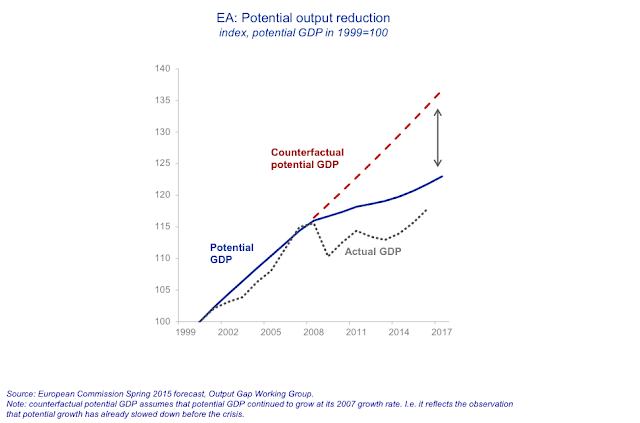
" The euro area economy is gradually emerging from a deep and protracted downturn. However, despite improvements over the last year, real GDP is still below the level of the first quarter of 2008. The picture is more striking still if one looks at where nominal growth would be now if pre-crisis trends had been maintained." So said Peter Praet, Member of the Executive Board of the ECB, in a recent presentation to the FAROS Institutional Investors' Forum. He's not wrong. From his presentation, here is a chart showing the difference between current output, current (estimated) potential output and projected output prior to 2007: That is indeed a striking gap. It is reflected in this chart from Eurostat (August 2015): So, the fall in GDP growth between 2007 and 2015 has resulted in a rise in unemployment of nearly 4 percentage points. Currently, across the Euro area as a whole (population about 340m), adult unemployment stands at 11% and youth unemployment ...

The dangers of historical taboos

Image
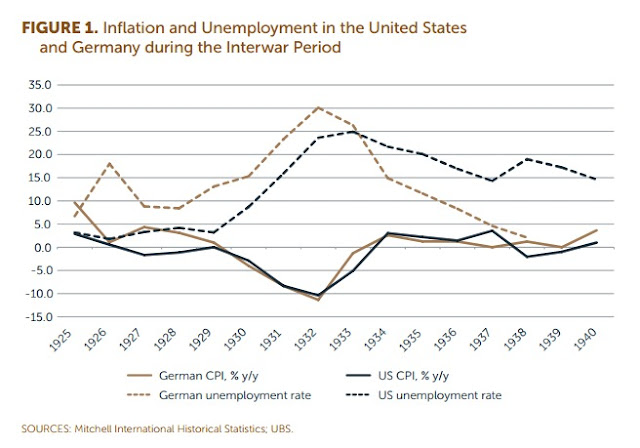
The Group of 30 central bankers and economists has produced a new report, "Fundamentals of central banking: lessons from the crisis". It traces the history of central banking theory and practice, including the economic thought that underlies it. And it draws from it some important lessons about the causes of the 2008 crisis and the reasons for the very long, slow recovery. I've discussed the main themes of the report here (Forbes). But in this post, I want to focus on a particular piece of economic history. This chart leapt out at me from the report: Note that this chart starts only two years after the Weimar hyperinflation, hence Germany's elevated inflation rate at the start. This is important, as we shall see. What struck me is how similar the profiles of the two countries are during the Depression. Both experienced Fisherian debt deflation - annualised CPI fall at peak was 10% for both countries. And both had very high levels of unemployment. German unem...

A poignant reminder

Image
While in Washington DC last week, I visited the Franklin D. Roosevelt memorial - a beautiful, peaceful construction on the banks of the Potomac Tidal Basin. This is one of the walls of the memorial. On it is a quotation that made me weep. My grief was not for the Americans whose lives were wrecked by the terrible unemployment of the Great Depression, about whom FDR was speaking. No, it was for Europe. For the millions of Europeans whose lives are being devastated by the unemployment plague that is currently sweeping Europe. And for those in power in Europe, who do not share FDR's outrage at the ruin of lives and hopes, and who use weasel words such as "structural reform" and "internal adjustment" to blind themselves and others to the human tragedy of unemployment. Adult unemployment in the Eurozone is currently over 11%. Even in the wider EU it is nearly 10%. Compare this with Japan and the USA: These statistics are bad enough. But there is a wide s...

Structural destruction

Image
Researchers at the Federal Reserve recently produced a fascinating article in which they argued that severe recessions such as that in 2008-9 leave permanent economic scars.This set of charts shows the effect of the 2008-9 recession on real GDP trend growth for four economic areas - the US, the UK, the Euro area and Canada: This reminds me of the four-image game on the UK's satirical current affairs show " Have I Got News For You ". Spot the odd one out, and explain why.....and no, it isn't the one you think it is. Actually each chart has a claim to be the odd one out, which just goes to show how the economic effects of the financial crisis varied by country. Or perhaps more accurately, how the response to the crisis by monetary and fiscal authorities varied. These charts show a significant drop in trend RGDP for all four economic areas: Canada, which had neither a property market crash nor a banking crisis, shows the smallest fall. Interestingly - and c...