Posts

Showing posts with the label central banks

There's no such thing as a safe stablecoin
Image
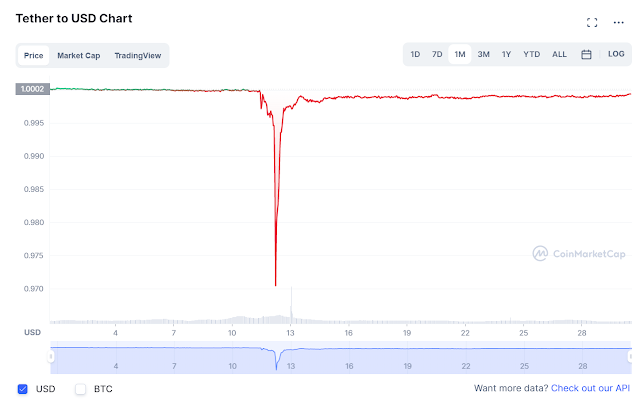
 Stablecoins aren't stable. So-called algorithmic stablecoins crash and burn when people behave in ways the algorithm didn't expect. And reserved stablecoins fall off their pegs - in either direction. A stablecoin that does not stay on its peg is unstable. Not one of the stablecoins currently in circulation lives up to its name.  Don't believe me? Well, here's the evidence. Exhibit 1, USDT since the end of April: Exhibit 2, USDC over the same time period: (charts from Coinmarketcap) Both coins de-pegged on 12th May. Neither has returned to par. Stable, they are not.  And no, USDC is not "more stable" than USDT. A stablecoin that can't hold its peg when everyone is piling into it is no more stable than one that can't hold its peg when everyone is selling it. Indeed, since stablecoins can be created without limit, there is arguably much less excuse for a stablecoin de-pegging on the upside. Stablecoin issuers can run out of reserves, but they can't r...

How central banks can fight climate change

Image
This is the uncut version of the final chapter of my book, "The Case for People's Quantitative Easing". It was written May/June 2018, so is slightly out of date (though I have updated it in places). But I believe its conclusions are right. So I am publishing it now to coincide with COP 26.  I've also included an updated version of the original postcript of the book, which seems to me to be very relevant now - not least because the first part of the Dune epic has just been released! There is scientific consensus that climate change is radically changing the nature of the planet, with profound implications for the future of humanity and indeed for life on earth as we know it. Already, the effects are becoming apparent: ice caps are melting, sea levels are rising, global temperatures are the highest on record and the incidence of extreme weather events is increasing. According to the former Governor of the Bank of England, Mark Carney, climate change threatens both fina...

David and Goliath

Image
Yesterday, someone who had been watching one of my (all too frequent) Twitter arguments about money made this comment:  The "unknown person with few followers" was my protagonist. And the blue tick "classical expert" was me. I am Goliath.  But ten years ago, I was David. Armed only with Blogger and Twitter, and my knowledge of banking and finance, I set out to slay the financial Philistines that rampaged across the internet in the aftermath of the 2008 financial crisis. I published my first Coppola Comment post on 20th February, 2011. It throws slingshots at a media pundit who had written an article about short selling, on which he was far from expert. You can still read it , if you like.  My early posts were rough and ready, and my terminology is at times excruciatingly loose, but I was sure of my subject. I understood British banking and financial markets well, though I had left RBS nearly ten years before. It was evident to me that the 2008 financial crisis in th...

Britain was not "nearly bust" in March

Image
"Britain nearly went bust in March, says Bank of England", reads a headline in the Guardian . In similar vein, the Telegraph's Business section reports "UK finances were close to collapse, says Governor": Eh, what? The Governor of the Bank of England says the UK nearly turned into Venezuela? Well, that's what the Telegraph seems to think:  The Bank of England was forced to save the Government from potential financial collapse as markets seized up at the height of the coronavirus crisis, Governor Andrew Bailey has said. In his most explicit comments yet on the country's precarious position in mid-March, Mr Bailey said 'serious disorder' broke out after panicking investors sold UK government bonds in a desperate hunt for cash. It left Britain at risk of failing to auction off the gilts needed to fund crucial spending - and Threadneedle Street had to pump £200bn into markets to restore a semblance of order. Reading this, you would think that the UK...

Pandemic economics: the role of central banks and monetary policy

Image
Below are the slides from my presentation at Beyond Covid on 12th June. The whole webinar can ve viewed here . The pandemic seems to me to resemble the "nuclear disaster" scenarios of my youth: hide in the bunker, then creep out when the immediate danger is over, only to find a world that is still dangerous and has fundamentally changed in unforeseeable ways.  Rabbits hiding from a hawk is perhaps a kinder image, though hawks don't usually leave devastation in their wake. And I like rabbits. So this presentation is illustrated with rabbits, not nuclear bombs.  This is where we were in March/April/May. Hiding in our homes, waiting for the danger to pass: And this is what central banks should have been doing then: To their credit, this is exactly what they did. By supporting sovereign finances and warding off a financial crisis, they enabled fiscal authorities to take the extraordinary measures needed to keep people and businesses alive in their burrows.  Some economists mi...

Doing "Whatever It Takes"

Image
The economy slumbers in its induced coma. Businesses are closed, workers furloughed or laid off. But the astonishing headline falls in economic indicaters such as GDP and PMI conceal a grim reality. Businesses are closing not just because they have been ordered to do so, but because they are running out of money. And people who have lost their jobs or become ill are also running out of money. If businesses fail instead of being mothballed, the eventual economic recovery will be slow. And if people die of starvation or untreated disease, what is the point of the lockdown? Everyone agrees that there is an urgent need to get money to people and businesses so they can stay alive. But the waters are being muddied by terms such as "helicopter money" and "people's QE" being bandied about with little thought as to what they are, or whether they really would meet the current need. So I want to start by clarifying what, in my view, these terms mean. In my book, I...