Posts

Showing posts with the label interest rates

Britain was not "nearly bust" in March

Image
"Britain nearly went bust in March, says Bank of England", reads a headline in the Guardian . In similar vein, the Telegraph's Business section reports "UK finances were close to collapse, says Governor": Eh, what? The Governor of the Bank of England says the UK nearly turned into Venezuela? Well, that's what the Telegraph seems to think:  The Bank of England was forced to save the Government from potential financial collapse as markets seized up at the height of the coronavirus crisis, Governor Andrew Bailey has said. In his most explicit comments yet on the country's precarious position in mid-March, Mr Bailey said 'serious disorder' broke out after panicking investors sold UK government bonds in a desperate hunt for cash. It left Britain at risk of failing to auction off the gilts needed to fund crucial spending - and Threadneedle Street had to pump £200bn into markets to restore a semblance of order. Reading this, you would think that the UK...

Too Good To Be True

Image
" USD-backed stablecoin is 10x better than your savings account ," runs the headline on an unsolicited press release in my inbox yesterday. And it goes on to explain: The average interest rate for savings accounts in the US currently stands at 0.09%, with some German banks even charging negative interest rates. Universal Protocol, a coalition of leading blockchain organizations, including Uphold, Cred, Blockchain at Berkeley, and Bittrex Global, has recently introduced interest rates of 10% p.a. for its USD-backed stablecoin UPUSD.  Ok, so they are issuing an altcoin at high interest rates. Why are they comparing this with FDIC-insured savings accounts? The UPUSD is a fully-transparent digital asset that is collateralized 1-to-1 with US dollars and held at US-domiciled, FDIC-insured banks.  FDIC-insured banks don't hold digital assets. They hold US dollars. So this should read "collateralized 1-to-1 with US dollars held at US-domiciled, FDIC-insured banks...

Yield curve weirdness

Image
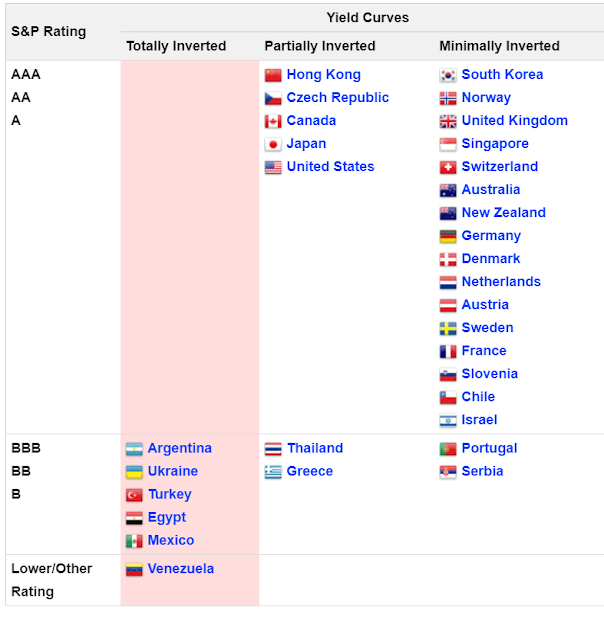
Yield curves have gone mad. Negative yields are everywhere, from AAA-rated government bonds to corporate junk . Most developed countries have inverted yield curves, and a fair few developing countries do too: (chart from worldgovernmentbonds.com) Negative yields and widespread yield curve inversion, particularly though not exclusively on safe assets. To (mis)quote a famous pink blog , this is nuts, but everyone is pretending there will be no crash. Here, for your enjoyment, is an à la carte selection of the most lunatic government yield curves. You can find lots more here . Exhibit 1: Switzerland. Negative yield already extends beyond 30 years, and markets are pricing in further interest rate cuts and/or QE, or indeed anything to stop the Swiss franc appreciating as scared investors pile into CHF-denominated assets. Hence the curve inversion. Exhibit 2: Denmark. Every Danish government bond currently circulating in the market is trading at a negative yield. And the in...

Keynes and the death of capitalism

Image
In a recent article for the New Statesman , the economics commentator Grace Blakeley makes an extraordinary claim. Writing about the origins of the IMF, she says: Seventy-five years have passed since these international financial institutions were created in Bretton Woods, New Hampshire, in 1944. Back then, delegates sought to tame the power of international finance, the growth of which helped to cause the 1929 Wall Street Crash and the ensuing Great Depression. JM Keynes – who led the British delegation – arrived at Bretton Woods with the aim of “euthanising” a financial elite he viewed as parasitic on productive economic activity. I thought that Bretton Woods was about free trade and economic cooperation, not "taming the power of international finance." But I can be wrong. So I checked it out. According to the U.S. State Department , Bretton Woods was indeed born from the U.S.'s dreadful experience in the worldwide depression of the early 1930s. But it was no...

Weird Is Normal

Image
This post was originally published on Pieria in December 2013. Since then, the idea that the long-term real equilibrium interest rate must be equal to or lower than the long-term sustainable growth rate has become much more mainstream. I am just amazed that anyone ever thought it could be otherwise. A long-term real interest rate persistently above the sustainable growth rate cannot possibly be an "equilibrium" rate. As I show in this piece, it can only be maintained through rising inequality. It is by definition ponzi and therefore unsustainable. Periodic financial crashes are inevitable in any system in which growth does not cover the interest on debt.  Three years ago, Nick Rowe produced this post describing a “weird world” – a world in which the equilibrium interest rate is at or below the long-term growth rate of the economy, rather than above it as we are used to. In such a world, bubbles are inevitably created as investors search for positive yield. This is al...

Central banks' credibility problem

Image
In a speech in London the other day, Peter Praet discussed the ECB's unconventional policy measures. I was there, and I have to say that he deviated considerably - and rather entertainingly - from the version of the speech on the ECB website. But his core message was still the same: "Rates are expected to remain at their present levels for an extended period of time, and well past the horizon of our net asset purchases. So, no interest rate hikes for a long time to come. But that's not what his final chart says: Market expectations are that interest rates will start to rise any day now. And no, this is not expectations of rate rises due to the end of QE, which the ECB has arguably signalled for early 2018 (or at least it didn't signal that it wouldn't end then). This is the short-term rate, which is not directly affected by QE. Admittedly, future expectations of short-term rates in 2018 and beyond are close to the ECB's own predictions. But is that b...

Raising interest rates is not that simple, Lord Hague

Image
The present period of very low interest rates is widely assumed to be temporary, a consequence of the 2008 financial crisis and subsequent central bank action. Because of this, as the financial crisis fades into the mists of time, there is growing political pressure for "normalisation" of interest rates. Here, for example, is William Hague warning that central banks must start to raise rates or face losing their independence: The only way out is for the US Fed to summon the courage to lead the way to higher interest rates, and others to follow slowly but surely. If they fail to do so, the era of their much-vaunted independence will come, possibly quite dramatically, to its end. Hague gives ten reasons why low interest rates are a bad idea. His points can be summarised thus: the "reach for yield" by savers who want higher returns drives up the price of assets higher asset prices increase wealth inequality, fuelling popular anger pension funds are struggling, ...