Posts

Showing posts with the label government

We need to talk about the state pension

Image
My post-Budget article for the Radix thinktank considers the future of the State Pension in the light of the Chancellor's changes to National Insurance.  The headline news in the Budget was a 2p cut in the main rate of National Insurance contributions for employed and self-employed people. This was the second such cut, the first being in the Autumn statement. And the Chancellor expressed an intention to go much further. He trailed the idea of abolishing personal National Insurance completely.  These changes will have far-reaching implications for the state pension...  To read the rest of the post, click here .  Related reading: The Fund that isn't a fund

The foolishness of the old

Image
Most people want government to spend more money on them than on anyone else. This applies regardless of their tax contributions (those who don’t pay tax often demand more than those who do). And it is completely understandable. After all, charity begins (and when times are hard, ends) at home. So when voters in the US were asked what the government’s spending priorities should be, it comes as no surprise to discover that their preferences varied by age: As we would expect, the priorities of the young are education and jobs, the priorities of those of working age are jobs and benefits, while the priorities of the middle-aged and old are pensions and associated benefits (US pensions, pensioner benefits, Medicare, disability benefits and family support are all bracketed together as “social security”, but pensions are by far the largest proportion). Older people are also much more concerned about defence, no doubt because they have lived through successive wars and threats of w...

Raising interest rates is not that simple, Lord Hague

Image
The present period of very low interest rates is widely assumed to be temporary, a consequence of the 2008 financial crisis and subsequent central bank action. Because of this, as the financial crisis fades into the mists of time, there is growing political pressure for "normalisation" of interest rates. Here, for example, is William Hague warning that central banks must start to raise rates or face losing their independence: The only way out is for the US Fed to summon the courage to lead the way to higher interest rates, and others to follow slowly but surely. If they fail to do so, the era of their much-vaunted independence will come, possibly quite dramatically, to its end. Hague gives ten reasons why low interest rates are a bad idea. His points can be summarised thus: the "reach for yield" by savers who want higher returns drives up the price of assets higher asset prices increase wealth inequality, fuelling popular anger pension funds are struggling, ...

Keynes and the Quantity Theory of Money

Image
"Best diss of the Quantity Theory of Money comes from Keynes", commented Toby Nangle on Twitter, referring to this paragraph from Keynes's Open Letter to Roosevelt   (Toby's emphasis) : The other set of fallacies, of which I fear the influence, arises out of a crude economic doctrine commonly known as the Quantity Theory of Money. Rising output and rising incomes will suffer a set-back sooner or later if the quantity of money is rigidly fixed. Some people seem to infer from this that output and income can be raised by increasing the quantity of money. But this is like trying to get fat by buying a larger belt. In the United States to-day your belt is plenty big enough for your belly. It is a most misleading thing to stress the quantity of money, which is only a limiting factor, rather than the volume of expenditure, which is the operative factor. But is Keynes really dissing the Quantity Theory of Money (QTM)? Well....no. He is objecting to the way in which it...

The Slough of Despond

Image
I'm bored. Bored with this crisis. Bored with endless calls for bank reforms. Bored with never-ending stories of inadequate bank resolution and legal battles which benefit no-one but lawyers. Bored with ineffectual monetary policy and fiscal gridlock. Bored with seeing the same things proposed over and over again, even things we know don't work and will never happen. Today, Mike Konczal wrote a piece on why restoring Glass-Steagall wouldn't solve anything. He's right, of course. But it is now seven years since the crisis, and we have known for most of that time that restoring Glass-Steagall wasn't going to happen and wouldn't solve anything anyway.Why are we still discussing it now? Why can't we just accept that Glass-Steagall is dead , and move on? Today, I had to explain YET again that although banks create money when they lend, that does not mean lending doesn't need funding. Payments are deposit outflows. That applies whether the deposits co...

Investment is needed everywhere

Image
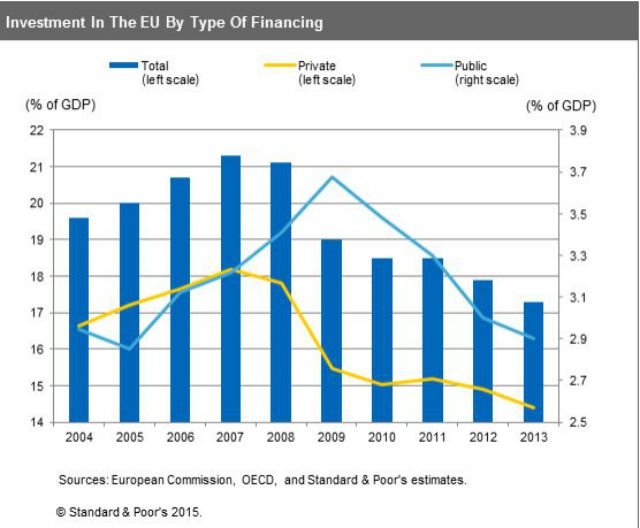
And particularly in Europe, as this chart shows: The ratings agency Standard & Poors  has called  for governments everywhere to increase investment spending. It also says they need to improve the efficiency of the spending they are already doing.  Private sector investment spending all over the world fell after the 2008 financial crisis. In Europe, where the crisis started earlier, it started falling in 2007. And it has not recovered. Private sector investors remain risk-averse and fearful of losses, chasing safe havens and unwilling to invest long-term in infrastructure, skills and R&D. When the private sector will not invest, the job falls to government. And immediately after the financial crisis, governments did step up, increasing investment spending as private sector investment fell. Some governments have continued to invest ever since, notably China, which still spends about 8.5% of GDP every year (much of it outside its borders), and India, which...

Everything's under control, China edition

Image
Daiwa Securities has forecast Armageddon. They say that over-investment in China in recent years has created a debt bubble so great that Chinese authorities would not able to manage its collapse, resulting in a debt deflationary spiral which would make 2008 look like a walk in the park. Such a meltdown would, in their words, "send the global economy into a tailspin". But they also outline another scenario, in which China's economy undergoes a nasty, possibly prolonged recession, from which it will emerge with lower growth. Which of these scenarios will play out? Well, as I discuss in my latest Forbes post, it really depends what Chinese authorities do. They insist that "everything is under control". But are they actually in the wrong trousers? Read my analysis and conclusions here . Related reading: Never mind Greece, look at China Lessons for China from Japan China's economy: no collapse, but it's serious and so are the politics - Georg...

Making the case for public investment

Image
Jeremy Corbyn’s “People’s QE” scheme has been extensively discussed in the media. In fact it has caused something of a storm. The FT’s Chris Giles did an excellent balanced analysis of it, and there have also been useful contributions from – among others - Oxford University’s Simon Wren-Lewis , The Economist’s Buttonwood and FT Alphaville’s Matt Klein . The extent of discussion is far more, in my view, than the scheme deserves. The scheme envisages that the Government, via a public investment bank, would issue bonds for infrastructure development, which would then by bought by the Bank of England as part of a QE programme. The architect of the scheme, Richard Murphy, suggests that to avoid accusations of monetary financing of government – which is a breach of the UK’s obligations under the Lisbon Treaty – the bonds would be issued to the private sector initially at a price set by the Bank of England, which would then hoover them up in (presumably compulsory) secondary pur...

Krugman, Bowman and the monetary financing of governments

Krugman says central banks can't create inflation. When interest rates are at zero, expanding the monetary base makes no difference. This is, of course, anathema to dedicated believers in the omnipotence of central banks . But Krugman is in good company. I recently heard Richard Koo speak on lessons from Japan for the Eurozone. Koo questioned QE's effectiveness when the private sector is refusing to take on more debt because it is determined to deleverage. Koo's and Krugman's scenarios are actually the same, though they attack the problem from different angles. In both cases, interest rates are zero, though Krugman explains this as an infinite demand for interest-free money (the liquidity trap), and Koo explains it as a lack of demand for borrowing. Both argue that central banks are unable to generate inflation when the private sector does not wish to spend. Both insist - though for different reasons - that when interest rates are zero, fiscal stimulus is needed to...

Three silly charts

From Fraser Nelson's Twitter stream come the following charts, with associated twitter commentary. Worth remembering: debt is growing WAY faster than the economy. Right now, £2 borrowed for every £1 of growth (pic) pic.twitter.com/wG8Pd45Tlj — Fraser Nelson (@FraserNelson) October 26, 2013 For purists here's the latest, soaring debt/GDP ratio. Just as scary. pic.twitter.com/xOpJYJIA5u — Fraser Nelson (@FraserNelson) October 26, 2013 And finally, for the record, this shows how Osborne will up national debt more in 5 yrs than Labour did in 13 yrs. pic.twitter.com/N1o1R2ZOqQ — Fraser Nelson (@FraserNelson) October 26, 2013 There are of course going to be lots of people who think my description of these as "silly" is mistaken or incomprehensible. So let me explain. Chart 1 compares the increase in government debt with the increase in GDP since 2010. I'm afraid this is meaningless. Debt is a stock: it is taken on at a point in time, paid down a...