Posts

Showing posts with the label pensions

We need to talk about the state pension

Image
My post-Budget article for the Radix thinktank considers the future of the State Pension in the light of the Chancellor's changes to National Insurance.  The headline news in the Budget was a 2p cut in the main rate of National Insurance contributions for employed and self-employed people. This was the second such cut, the first being in the Autumn statement. And the Chancellor expressed an intention to go much further. He trailed the idea of abolishing personal National Insurance completely.  These changes will have far-reaching implications for the state pension...  To read the rest of the post, click here .  Related reading: The Fund that isn't a fund
Statistics for state pension age campaigners

Image
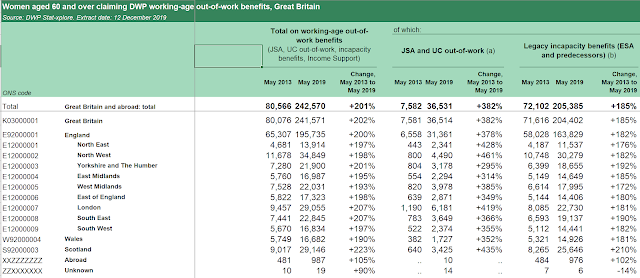
Another day, another takedown of claims made by women's state pension age campaigners. This time, it's figures for benefit claims by women in their early 60s. David Hencke claims that sharp rises in the number of women in this age group claiming unfit-for-work benefits (ESA and legacy incapacity benefits) proves that losing their state pension entitlement is wrecking the health of women in this age group. And he argues that this calls into question the DWP's recent victory in the Court of Appeal: The disclosure of these figures -obviously not available at the time of the hearing – does undermine the forceful case made by Sir James Eadie, QC, who represented the Department of Work and Pensions, that any poverty or ill health suffered by these women could not be linked to the rise in the pension age to 66. Unfortunately, it doesn't.   The figures released by the Commons Library on 18th September 2020 do indeed look damning. Here's an excerpt from their table, in whic...

The true story of NI autocredits

Image
In Waspiland, there's a  claim  doing the rounds that women have been unfairly treated regarding National Insurance (NI) contributions. Specifically, that men received NI credits enabling them to retire at 60, while women had to work till 66. As is so often the case with claims made by Waspi - or in this case, the hardcore Back to 60 group - the truth is rather different. Men did receive NI credits, yes, but there was no unfairness to women. Rather, the unfairness was to men.  As always, the story starts with the unequal state pension ages of men and women. When the present state pension system was introduced in 1946, women's state pension age was set at 60, and men's was 65. To qualify for a full state pension, women had to make 39 years of NI contributions: because their state pension age was 5 years later, men had to make 44 years of contributions.  During the inflationary 1970s, unemployment gradually rose to the highest levels since the Great Depression. Youth u...

The NI Fund's reserves don't pay down the National Debt

Image
The NI Fund discussed in this post covers England, Wales and Scotland only. Northern Ireland has a separate NI Fund, which is excluded from the figures given in this post. However, it works in exactly the same way as the Fund discussed here.  Sometimes the government is its own worst enemy. HM Treasury's hamfisted response to this Freedom of Information request from Trudy Baddams of the pension rights campaign group "We Paid In, You Paid Out", has caused a very silly storm. Ms Baddams asked this question: Can you confirm that the National Insurance Fund (NIF) is presently in surplus and by how much? Can you also please confirm how much has been paid from the fund into the National Insurance Investment Fund in the last 10 years? In response, HM Treasury pointed her to the NIF accounts , which are produced yearly. But then it added this paragraph (my emphasis): The latest NIF Accounts show that the balance of the NIF increased by £2,286,469,000 in 2017-18. ...

The foolishness of the old

Image
Most people want government to spend more money on them than on anyone else. This applies regardless of their tax contributions (those who don’t pay tax often demand more than those who do). And it is completely understandable. After all, charity begins (and when times are hard, ends) at home. So when voters in the US were asked what the government’s spending priorities should be, it comes as no surprise to discover that their preferences varied by age: As we would expect, the priorities of the young are education and jobs, the priorities of those of working age are jobs and benefits, while the priorities of the middle-aged and old are pensions and associated benefits (US pensions, pensioner benefits, Medicare, disability benefits and family support are all bracketed together as “social security”, but pensions are by far the largest proportion). Older people are also much more concerned about defence, no doubt because they have lived through successive wars and threats of w...

The real victims of the "Rape of the National Insurance Fund"

Image
In a recent article , David Hencke claims that politicians of all three main parties agreed to raise the state pension age for women to compensate for the ending of the Treasury's contribution to the National Insurance fund. This isn't true. Not only is it untrue, but it directly contradicts the research upon which his article relies, and dishonours the memory of a man who fought hard for pensioners' rights. Hencke based his article on this piece  by Tony Lynes, written in 2006 as a basis for a National Pensioners Convention factsheet on the National Insurance (NI) Fund. As readers of this blog will know, the NI Fund is not a pension fund. It is a clearing house for receipt of NI contributions and their disbursement to pensioners and beneficiaries. Tony Lynes describes its workings perfectly: National Insurance is the system through which contributions by working people and employers are paid into a fund - the National Insurance Fund - to finance a range of benefit...

Now state pension ages are equalised, let's fix the real problems

Image
Today is a day for celebration. After nearly 60 years of inequality and discrimination - originally against women, and more recently against men - the state pension age is at last the same for men and women. For one day only, both men and women will retire at 65. Tomorrow, the state pension age for both men and women will start rising again in lockstep, reaching 66 by 2020 and then to 67 and 68. I make no apology for celebrating the equalisation of pension ages. In my view this is long overdue. I have expected it all of my working life, having first discussed it when I was still at school. I never thought it was fair that my brother 14 months younger than me should receive his state pension 6 years and 4 months later than me. We both work for our livings and we have both brought up children. Life has dealt us different cards - I am significantly poorer than him - but that is not a reason for me to have a much earlier state pension purely by virtue of being female. That said, t...

Demolishing a straw man

Image
This is David Hencke's response to my comment on his blog . You can find the Coppola Comment version of my comment here . For the record while not replying to all your points. 1. I cover a wide range of topics on my blog – child sex abuse, domestic violence, bad treatment of the disabled, the rise of Jeremy Corbyn, dodgy privatisations, institutional racism etc. 2. Given the government has to write to everyone telling them when their pension is due, it is not beyond the wit of man or woman to tell everyone personally when the change came into effect. 3 your main point seems to be that pensions are not a right but a benefit that presumably could be means tested. I am afraid they are not marketed like that – with all the qualifying rules for NI to get one for a start. they are still a universal benefit and therefore I am drawing one at the moment and long may it continue. 4. You seem to fall into the trap that many other well off people do ( I am not saying you are well...

Calculus for journalists

Image
“What do they teach them at these schools?” wondered the Professor in C.S. Lewis's The Lion, the Witch and the Wardrobe.  The Professor, of course, was concerned about logic. But I wonder too - not about logic, but about maths. Especially among journalists writing about life expectancy and other long-term trends. Here is the FT proclaiming "Average life expectancy falls". This is the headline for a chirpy piece about how reduced life expectancy could make things easier for pension funds facing big deficits.  There's only one problem with this. Life expectancy isn't falling. And the report the FT cites does not say that it is. This is how the press release from the Institute and Faculty of Actuaries summarises the findings of their report: Recent population data has highlighted that, since 2011, the rate at which mortality is improving has been slower than in previous years However, mortality is expected to continue to improve and there is signi...