Posts

Showing posts with the label financial crisis

Where has all the money gone?

Image
The collapse of Terra in May sent shock waves round the crypto world, triggering domino-like collapses of crypto companies. One of those companies was the investment fund Three Arrows Capital. At the time, everyone thought 3AC was a conservatively-managed investment company that was simply the unfortunate victim of an unforeseen event. If anyone was to blame for 3AC's collapse, it was Do Kwon.   How wrong they were. Since 3AC was ordered into liquidation by a British Virgin Islands court, more  and more creditors have emerged from the woodwork claiming they are owed money. The liquidators have filed emergency motions to freeze 3AC's assets because there is evidence that funds are being moved out of reach. And 3AC's co-founders, Su Zhu and Kyle Davies, have done a runner, though Bloomberg says they are planning to set up shop in Dubai.  The liquidators applied to the Singapore High Court to have the BVI liquidation order recognised in Singapore. This would give them a...

Britain was not "nearly bust" in March

Image
"Britain nearly went bust in March, says Bank of England", reads a headline in the Guardian . In similar vein, the Telegraph's Business section reports "UK finances were close to collapse, says Governor": Eh, what? The Governor of the Bank of England says the UK nearly turned into Venezuela? Well, that's what the Telegraph seems to think:  The Bank of England was forced to save the Government from potential financial collapse as markets seized up at the height of the coronavirus crisis, Governor Andrew Bailey has said. In his most explicit comments yet on the country's precarious position in mid-March, Mr Bailey said 'serious disorder' broke out after panicking investors sold UK government bonds in a desperate hunt for cash. It left Britain at risk of failing to auction off the gilts needed to fund crucial spending - and Threadneedle Street had to pump £200bn into markets to restore a semblance of order. Reading this, you would think that the UK...

European banks and the global banking glut

Image
In a lecture presented at the 2011 IMF Annual Research Conference, Hyun Song Shin of Princeton University argued that the driver of the 2007-8 financial crisis was not a global saving glut so much as a global banking glut. He highlighted the role of the European banks in inflating the credit bubble that abruptly burst at the height of the crisis, causing a string of failures of banks and other financial institutions, and economic distress around the globe. European banks borrowed large amounts of US dollars through the money markets and invested them in US asset-backed securities via the US's shadow banking system. In effect, they acted as if they were US banks, but in Europe and therefore beyond the reach of US bank regulation. This diagram shows how it worked (the “border” is the residency border beyond which US bank regulation has no traction): But it is not the model itself so much as Shin's remarks about the role of European regulation after the introduction of the...

Do you remember yesterday?

Image
It’s ten years since the fall of Lehman Brothers. Ten years…. but it seems much longer. I look back on the mid-2000s as if they were a past century. Those days are gone forever, and the future is increasingly dark and uncertain. How a single event can change the course of history... “Do you remember yesterday, that was a hundred years ago?” cries Lucretia in Benjamin Britten's The Rape of Lucretia, shortly before committing suicide. Lucretia's death was the event that brought about the fall of the Tarquin dynasty and the establishment of the Republic of Rome. A fundamental re-ordering of Roman society was triggered by a single act of betrayal. Tarquinius raped the wife of one of his senior generals. She committed suicide. Appalled, the Roman army overthrew him. No doubt Tarquinius had raped many other women. But Lucretia was a noblewoman and the wife of a loyal supporter. It was too much. History is scattered with similar triggers for earth-shattering political changes....

Probability for geeks

Image
The Lightning network is being touted as the solution to Bitcoin's scaling problems. If lots of transactions can be taken off the main chain, the thinking goes, then Bitcoin can still take over the world despite its considerable performance problems. Lightning enthusiasts say that when fully enacted, the network will be able to process millions of transactions at, er, lightning speed, without compromising decentralisation, security or transparency. But there are dissenting voices. For example, in this piece , Jonald Fyookball disputes the claims of the Lightning enthusiasts on the grounds that the mathematics doesn't stack up. Predictably, the Lightning geeks have fought back: the pseudonymous "Murch", a software engineer at the Bitgo cryptocurrency exchange, describes Fyookball's analysis as "laughable". Fyookball describes the Lightning network thus: To send or receive bitcoins, you need either a payment channel with that specific user, or a ...

Lehman's Aftershocks

Image
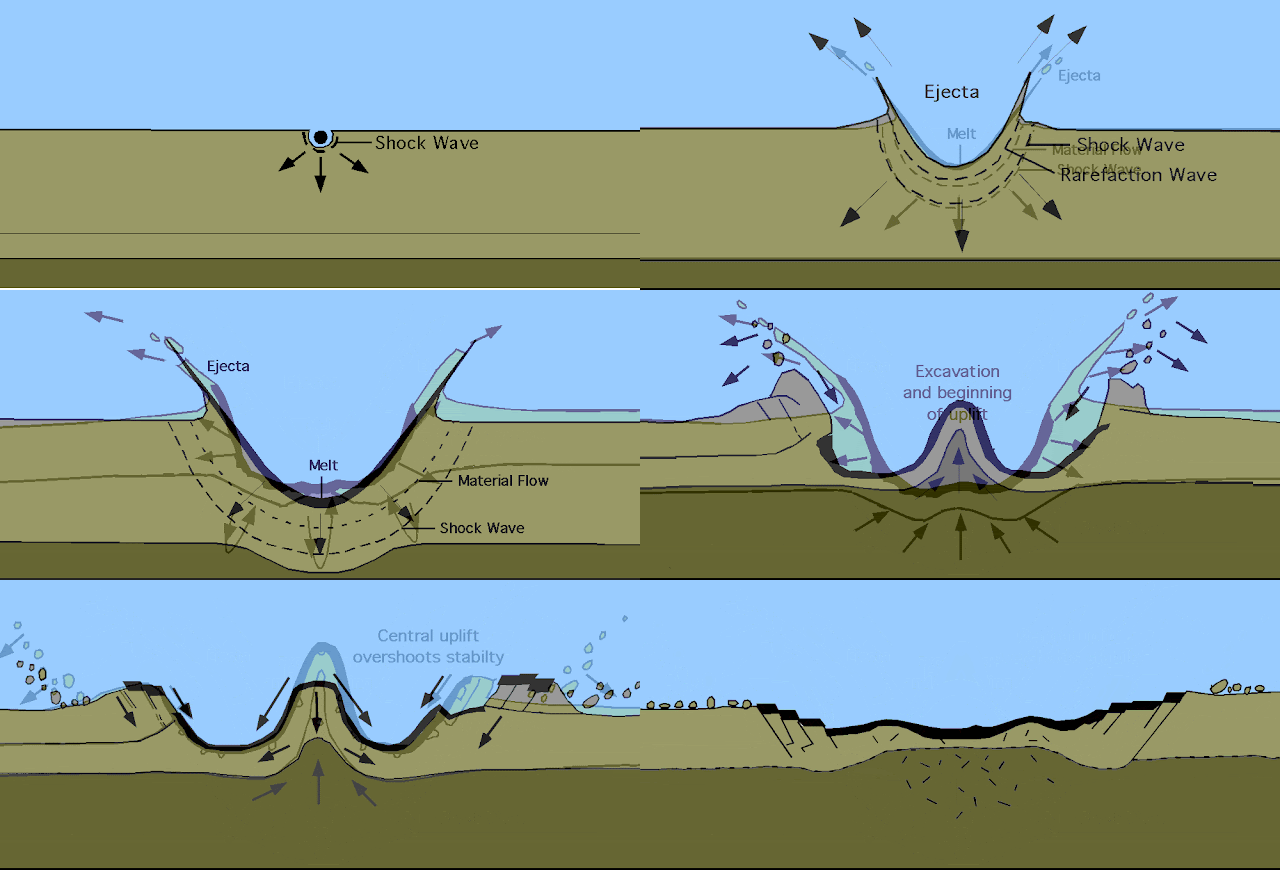
Peter Praet's speech at the Money, Macro and Finance conference last week was a goldmine. I've already discussed the central bank credibility problem revealed by his final slide. But his presentation went far, far wider than central banks. It raised serious questions about the future of the global economy. This slide - the first in his presentation - shows that there have been three significant global shocks in the last decade, not one: The first, obviously, is the deep global recession caused by the failure of Lehman Brothers in September 2008. But what are the other two? As Toby Nangle's annotations to Peter Praet's second chart show, the second is the Eurozone crisis, and the third is the emerging market crisis triggered by the unwinding of the oil & commodities boom: Looking at these charts made me think of ripples on a pond. When you drop a pebble into a pond, it initially creates a deep hole in the water, with raised sides and splashing. The ...