Posts

Showing posts with the label history

The Bitcoin Standard - a critical review

Image
For over a century now, the world has lacked a genuinely international means of payment. This is partly due to decisions made at the Bretton Woods conference in 1944, when the US dollar was adopted as the principal international settlement currency, rather than John Maynard Keynes's suggestion of an independent global currency that he called "bancor". Although the Bretton Woods gold-backed structure ended in 1971, the US dollar became ever more dominant. In 2008, the dollar's global reach enabled an American financial crisis to spread to the entire world, causing a deep recession and long-lasting malaise. Ever since, there has been a deep longing for a more stable international financial system, one which didn't depend on debt, wasn't dominated by the US and was immune to political whims. Some have called for a new Bretton Woods , or even for the return of the classical gold standard . Bitcoin emerged from the financial crisis as a fledgling internatio...
The terrible price of austerity

Image
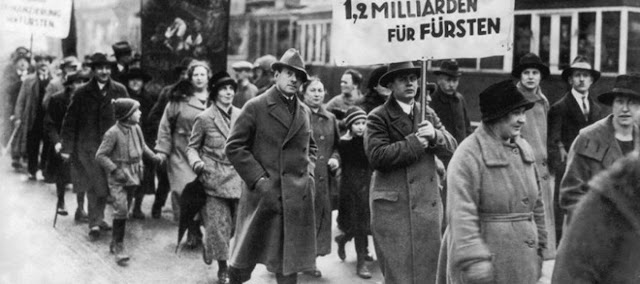
In August 2014, I wrote this post arguing that harsh austerity during the Depression caused Hitler's rise to power. At the time, my argument seemed controversial, at least in Germany. There, it is not the austerity of 1930-32 that is blamed, but the debt-driven hyperinflation of a decade earlier. Germans remain terrified of both inflation and debt to this day. I am certainly not the only person to identify a causative link between austerity and Hitler. Here is Paul Krugman slapping down Eduardo Porter in 2015, for example: Yes, there was a hyperinflation in 1923, which may have helped radicalize German politics. But the proximate factor in Hitler's rise to power was the great deflation of the 1930s, brought on by a disastrous attempt to stay on gold.  Disastrously staying on gold might of course have been due to the recent experience of hyperinflation. In 2014, when Bulgaria was unable to pay insured depositors for six months after a bank failure, the central bank ref...

A dent in the surface of time

Image
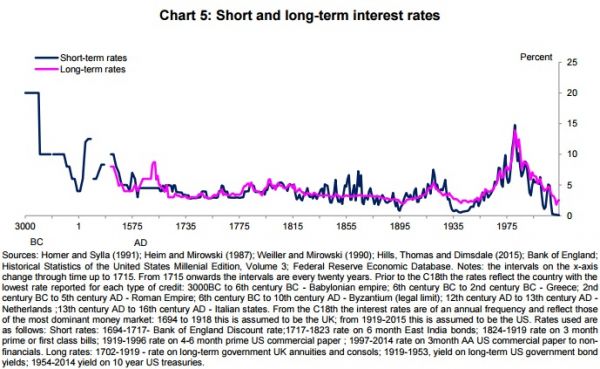
This chart has been fascinating me for ages. It was produced by the Bank of England to illustrate a speech by Andy Haldane . Shock, horror - we have the lowest interest rates for 5,000 years. Even in the Great Depression they were higher than they are now. These are, of course, nominal interest rates. Real interest rates are even lower - though not by much, since inflation is close to zero in all major economies. Note also the divergence of long-term and short-term interest rates. This is encouraging, since it suggests that investors view future prospects as brighter, though hardly scintillating. Central banks have been trying to close that gap with various monetary policy tools, the idea being to bring forward some of that future enthusiasm into the present day. But so far, all they have succeeded in doing is depressing expected interest rates far into the future. Now, policy makers are beginning to talk about interest rates remaining permanently lower than their long-run av...

The dangers of historical taboos

Image
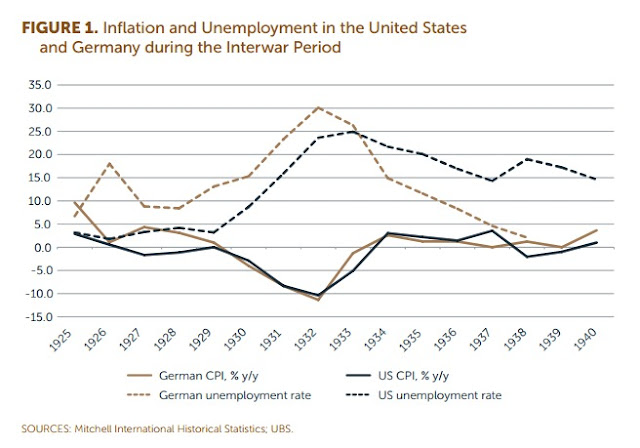
The Group of 30 central bankers and economists has produced a new report, "Fundamentals of central banking: lessons from the crisis". It traces the history of central banking theory and practice, including the economic thought that underlies it. And it draws from it some important lessons about the causes of the 2008 crisis and the reasons for the very long, slow recovery. I've discussed the main themes of the report here (Forbes). But in this post, I want to focus on a particular piece of economic history. This chart leapt out at me from the report: Note that this chart starts only two years after the Weimar hyperinflation, hence Germany's elevated inflation rate at the start. This is important, as we shall see. What struck me is how similar the profiles of the two countries are during the Depression. Both experienced Fisherian debt deflation - annualised CPI fall at peak was 10% for both countries. And both had very high levels of unemployment. German unem...

When the Nile floods fail

Image
I recently watched a BBC documentary on the fall of the Egyptian Old Kingdom . A thousand years of stability and prosperity came to an abrupt and chaotic end, apparently out of the blue. Most Egyptologists blamed dynastic change and political unrest. But something didn't quite add up. The end of the Old Kingdom coincided with terrible famines. To be sure, conflict can cause famines. But these were exceptional: thousands of deaths for years on end, people resorting to cannibalism, whole cities being abandoned. New research cast doubt on the "political change" theory for the collapse of the Old Kingdom. Sudden catastrophic climate change occurred at that time, causing a mini Ice Age in Europe and widespread famine around the world. In Egypt it resulted in the total failure of the annual Nile floods, upon which the Egyptian economy critically depended. No wonder it collapsed. But it took archeological research over 4000 years later to identify the massive exogenous shoc...